2026-10-14 早稲田大学
<関連情報>
- https://www.waseda.jp/inst/research/news/86278
- https://www.ovid.com/jnls/acsm-msse/fulltext/10.1249/mss.0000000000004164~cardiorespiratory-fitness-polygenic-risk-and-breast-cancer
閉経後女性における心肺機能、多遺伝子リスク、および乳がん:前向きコホート研究 Cardiorespiratory Fitness, Polygenic Risk, and Breast Cancer in Postmenopausal Women: A Prospective Cohort Study
Kumpei Tanisawa,Daiki Watanabe,Qian Li,Xiayue Fan,Xiaomin Sun
Medicine & Science in Sports & Exercise Published:October 06, 2026
DOI: 10.1249/MSS.0000000000004164
Abstract
Purpose:
Although cardiorespiratory fitness (CRF) is inversely associated with breast cancer risk, whether CRF modifies the association between breast cancer polygenic risk score (PRS) and incident breast cancer remains unclear. We examined the independent and joint associations of CRF and breast cancer PRS with incident breast cancer in postmenopausal women from the UK Biobank and evaluated multiplicative and additive interactions between CRF and breast cancer PRS.
Methods:
This prospective cohort study included postmenopausal women from the UK Biobank. CRF was estimated using a submaximal cycle ergometer test, and genetic susceptibility was assessed using a breast cancer PRS. Cox proportional hazards models adjusted for established breast cancer risk factors were used to estimate hazard ratios. Multiplicative and additive interactions between CRF and PRS were evaluated, with additive interaction assessed using the relative excess risk due to interaction (RERI).
Results:
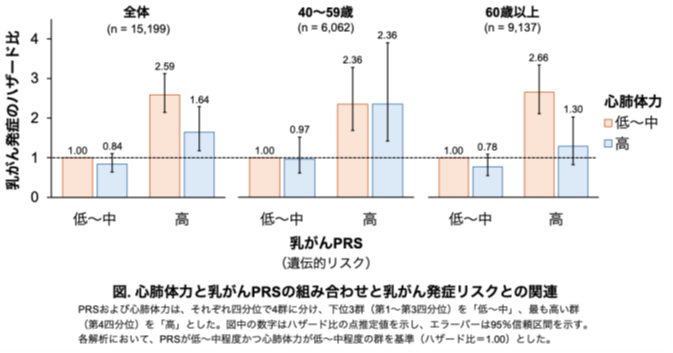
Among 15,199 postmenopausal women, 547 women developed incident breast cancer during a median follow-up of 10.7 years. Higher CRF was associated with lower risk of incident breast cancer in a dose–response manner, whereas higher PRS was associated with higher risk. Although multiplicative interaction was not significant, additive interaction analyses indicated that higher CRF was associated with attenuation of excess breast cancer risk conferred by high PRS (RERI −0.79, 95% CI −1.47 to −0.10). This attenuation was particularly evident among women aged ≥60 years.
Conclusions:
Higher CRF was associated with lower breast cancer risk and attenuation of excess breast cancer risk conferred by elevated polygenic risk, particularly among older women. These findings support the potential role of CRF in risk-stratified breast cancer prevention strategies.