2026-10-13 東京大学
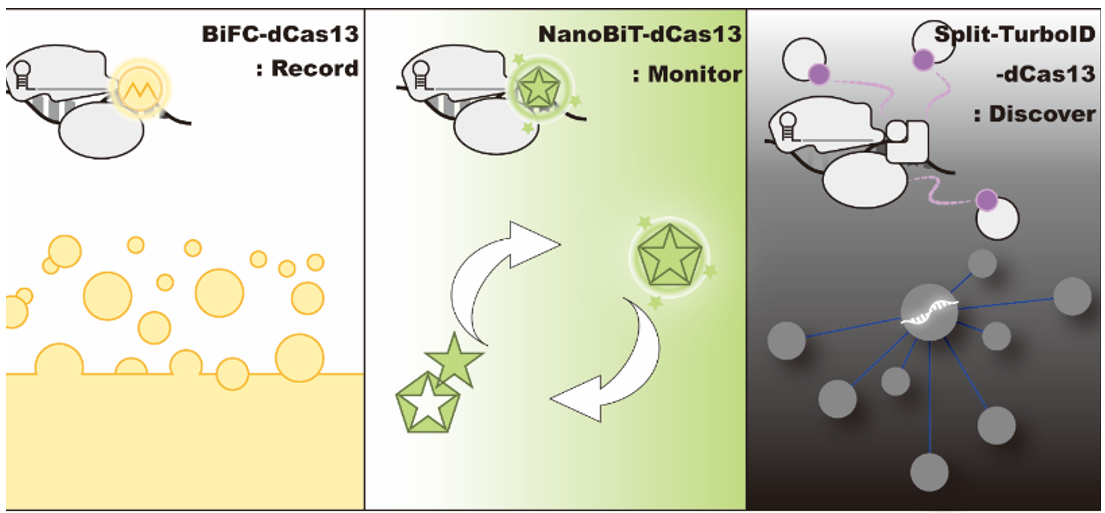
本研究で開発した三つのRNA-タンパク質相互作用解析技術の概念図
<関連情報>
- https://www.k.u-tokyo.ac.jp/information/category/press/0030779.html
- https://academic.oup.com/nar/article/54/18/gkag928/8872624
RNA-タンパク質相互作用を研究するためのCRISPR/Cas13ベースの分析ツールの開発 Development of CRISPR/Cas13-based analytical tools to study RNA–protein interactions
Keita Yamamoto, Shiori Shikata, Yangying Hao, Takuya Tomita, Rina Kanai, Els Verhoeyen, Yasushi Saeki, Susumu Goyama
Nucleic Acids Research Published:13 October 2026
DOI:https://doi.org/10.1093/nar/gkag928
Abstract
RNA–protein interactions (RPIs) are as important as protein–protein interactions (PPIs) for the formation of membraneless organelles (MLOs) and play vital roles in diverse biological processes. Despite remarkable advances in PPI analysis technologies, the development of tools for RPI analysis has lagged behind. To address this challenge, we integrated three established PPI technologies—bimolecular fluorescence complementation (BiFC), NanoBiT, and split-TurboID—with RNA-targeting CRISPR/dCas13. We applied these platforms to paraspeckles, a representative MLO formed through interactions between the long non-coding RNA NEAT1 and the RNA-binding protein NONO. BiFC-dCas13 functions as a fluorescence-based recorder that enables quantitative detection of NEAT1–NONO interaction events. NanoBiT-dCas13 precisely monitors dynamic changes in the NEAT1–NONO interaction through a reversible luminescence readout. Split-TurboID-dCas13 induces proximity-dependent biotinylation of proteins surrounding paraspeckles, identifying the N6-methyladenosine reader YTHDC1 as a paraspeckle-associated protein. Furthermore, BiFC-dCas13 was readily reconfigured to detect additional RPI pairs, demonstrating the modularity of the platform. Together, these complementary systems provide versatile approaches for recording, monitoring, and discovering RPI-associated biology and molecular environments.