2026-10-13 東京科学大学
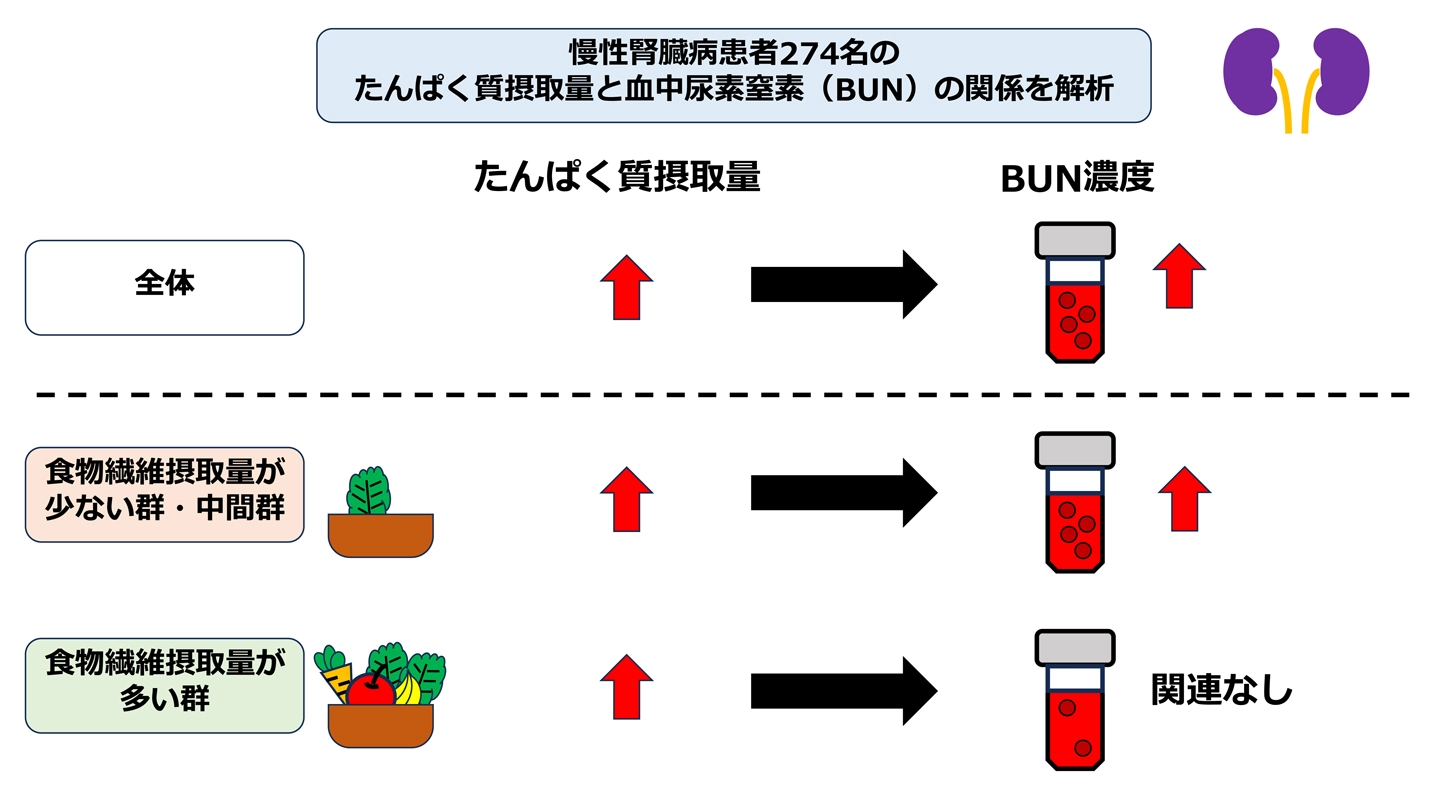
図1. 本研究で検証した関連性
<関連情報>
- https://www.isct.ac.jp/ja/news/ob86c242h0ke
- https://www.ovid.com/jnls/kidney360/fulltext/10.34067/kid.0000001350~dietary-fiber-attenuates-the-association-between-protein
食物繊維は慢性腎臓病患者におけるタンパク質摂取量とBUN値の関連性を弱める Dietary Fiber Attenuates the Association between Protein Intake and BUN in Patients with CKD
Nobuhisa Morimoto,Tamami Fujiki,Shintaro Mandai,Fumiaki Ando,Takayasu Mori,Koichiro Susa,Shotaro Naito,Eisei Sohara,Tatsuhiko Anzai,Kunihiko Takahashi,Wataru Akita,Akihito Ohta,Shinichi Uchida,Soichiro Iimori
Kidney360 Published:August 21, 2026
DOI:10.34067/KID.0000001350
Abstgract
Background:
While greater protein intake may contribute to BUN levels in patients with CKD, few studies have investigated whether dietary fiber modifies the association. We aimed to examine the effect modification of the association between protein intake and BUN by dietary fiber in patients with non-dialysis-dependent CKD.
Methods:
We included 274 patients (median age 72 years; 34% women) at three hospitals in Japan. Food group and nutrient intakes were estimated using a validated diet history questionnaire. We compared food group intake by dietary fiber tertiles. Multiple linear regression assessed the association between protein intake and BUN, adjusting for potential confounders. We performed stratified analyses by dietary fiber tertiles and interaction analyses.
Results:
The median (interquartile range) BUN was 24 (19–37) mg/dL, and the mean (standard deviation (SD)) estimated glomerular filtration rate was 33 (16) mL/min/1.73m2. The mean (SD) protein and fiber intakes were 39 (8) and 6.5 (2.2) g/1000 kcal/day, respectively. Patients with higher fiber intake had greater intake of fruits, vegetables, fish, and eggs than those with lower fiber intake. Protein intake was positively associated with natural log-transformed BUN (regression coefficient (β) = 0.05, 95% CI: 0.01 to 0.08, for one SD increase in protein intake). The association appeared stronger in the low-fiber (β = 0.08, 95% CI: 0.02 to 0.14) and medium-fiber groups (β = 0.08, 95% CI: 0.02 to 0.13), whereas it was not significant in the high-fiber group (β = 0.01, 95% CI: -0.03 to 0.06) (P for interaction = 0.10).
Conclusions:
The positive association between protein intake and BUN was attenuated in patients with high fiber intake, who had higher intakes of fruits, vegetables, fish, and eggs. Further studies are warranted to examine whether more liberal protein restriction is feasible in BUN management by increasing dietary fiber.