2026-10-13 早稲田大学
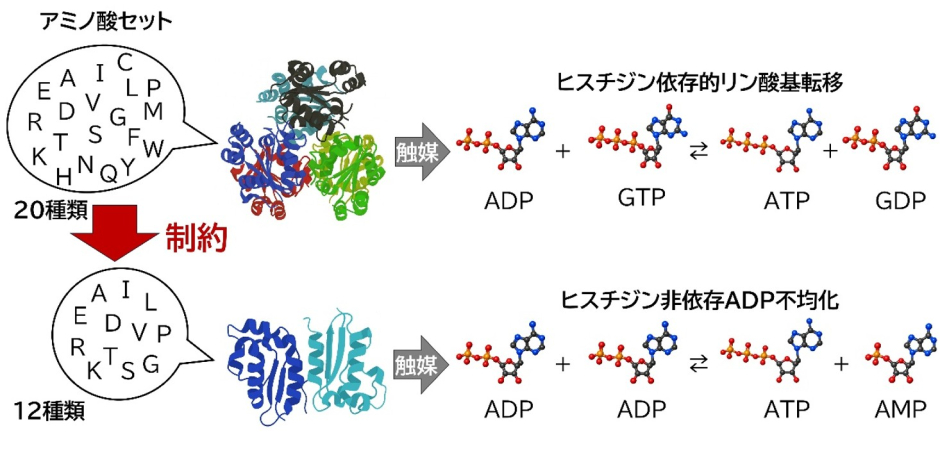
図1:アミノ酸組成の制約によるATP生成反応の切り替え。
<関連情報>
- https://www.waseda.jp/inst/research/news/86268
- https://onlinelibrary.wiley.com/doi/10.1002/anie.2166480
限られたアミノ酸セットを用いたATP生成リン酸転移化学の切り替え Switching ATP-Forming Phosphoryl-Transfer Chemistry With a Restricted Set of Amino Acids
Sota Yagi, Subrata Dasgupta, Shunsuke Tagami, Satoshi Akanuma
Angewandte Chemie International Edition Published: 09 October 2026
DOI:https://doi.org/10.1002/anie.2166480
ABSTRACT
Restricting amino acid diversity is expected to impair enzyme catalysis, but whether such constraints simply diminish catalytic activity or generate distinct catalytic chemistry remains unclear. We reconstructed an ancestral nucleoside diphosphate kinase (NDK) scaffold using 10 prebiotically plausible residues plus lysine and arginine. The resulting variant, Arc1-12KR, retained the canonical NDK fold in its crystal structure despite lacking the catalytic histidine. Chromatographic and mass spectrometric analyses showed ADP disproportionation to ATP and AMP, an activity undetectable in the NDK scaffold prior to amino acid reduction. Kinetic analysis showed nonlinear dependence on ADP concentration, and docking/molecular dynamics simulations indicated that the putative active-site region can accommodate two ADP molecules. These structural, computational, and mutational analyses suggest that compositional constraints reshape ATP-forming phosphoryl-transfer chemistry through a reorganized active site in which aspartate and arginine, together with coordinated Mg2+, may enable phosphoryl transfer via a noncanonical, histidine-independent mechanism. Despite modest catalytic efficiency, this activity represents a viable catalytic solution under compositional constraints, demonstrating that ATP formation can be supported by minimal amino acid repertoires. Thus, restricting amino acid diversity can generate distinct yet convergent ATP-forming catalytic solutions, which may represent chemically plausible early routes to ATP formation under primitive conditions.