2026-10-16 ワシントン大学セントルイス校
<関連情報>
- https://source.washu.edu/2026/10/new-discovery-may-point-to-clues-about-how-head-and-neck-cancers-spread/
- https://insidemedicine.washu.edu/new-discovery-may-point-to-clues-about-how-head-and-neck-cancers-spread/
- https://www.nature.com/articles/s41588-026-02723-7
頭頸部がんの空間分析により、上皮間葉転換の様式が異なる2つの生態系が特定された Spatial analysis of head and neck cancer identifies two ecosystems with distinct modes of epithelial-to-mesenchymal transition
Dor Simkin, Thomas F. Barrett, Lingling Zhang, Michael J. Moore, Alissa C. Greenwald, Noam Galili, Michael Mints, Salma Ramadan, Victoria Yu, Riley D. Z. Mullins, Jesse Zaretsky, Porter Bischoff, Douglas Adkins, Wade L. Thorstad, Sana D. Karam, Randall C. Paniello, Jason T. Rich, Ryan S. Jackson, Patrik Pipkorn, Paul A. Zolkind, Guangyong Peng, R. Alex Harbison, Rebecca Chernock, Anuraag S. Parikh, … Itay Tirosh
Nature Genetics Published:14 August 2026
DOI:https://doi.org/10.1038/s41588-026-02723-7
Abstract
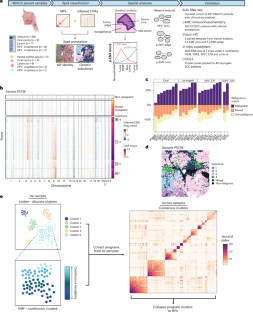
Head and neck squamous cell carcinoma (HNSCC) shows substantial intra- and inter-tumoral heterogeneity. We mapped tumor architecture across HPV-positive and HPV-negative HNSCC through spatial transcriptomics (n = 26). HPV-positive tumors display hypercellularity, higher lymphocyte presence, enriched hypoxia and reduced partial epithelial-to-mesenchymal transition (p-EMT) in malignant cells. We observed two distinct spatial architectures of p-EMT: p-EMT edge, where p-EMT is coupled to fibroblasts at the invasive front via TGFβ, and p-EMT core, in which tumor-infiltrating immunosuppressive macrophages and neutrophils induce p-EMT via oncostatin M in the core of tumor nests. These two p-EMT patterns were consistent across multiple samples from the same tumor, suggesting they are tumor-wide features. Together, these findings reveal that distinct interactions in the tumor microenvironment converge on a similar p-EMT cellular phenotype, but in a different spatial pattern that may have potential biological and clinical implications for our understanding of invasion, immune modulation and new targeted therapeutics for HNSCC.