
2026-11-17 東京科学大学
<関連情報>
地理的要因と食事が腸内細菌叢の構成およびゲノム変異に与える影響:5か国比較研究
Five-country analysis of geographic and dietary drivers of gut microbiome composition and genomic variation
Lora Khatib, Renee Oles, Alejandra Ríos Hernández, Tyler Myers, Jianshu Zhao, Megha Kumar, Ana Laroya, Veronica Tolosa-Enguis, Nobuko Matsunami, Daisuke Suzuki, Nodoka Chiba, Katharine E. Gilbert, Promi Das, Jon G. Sanders, Lucas Patel, Nicole Litwin, Brent Nowinski, Amanda Birmingham, Sawyer Farmer, Caitriona Brennan, MacKenzie Bryant, Caitlin Tribelhorn, Karenina Sanders-Bodai, Charles Cowart, Oliver Nizet, Edgar A. Diaz, Patrick Veiga, Sudarshan A. Shetty, Jan Knol, Christophe Lay, Hana Koutnikova, Soline Chaumont, Julien Tap, Aurélie Cotillard, Muriel Derrien, Manolo Laiola, Antonio González, Armando R. Tovar, Nimbe Torres, Yolanda Sanz, Takuji Yamada, Daniel McDonald, Se Jin Song, Andrew Bartko, Rob Knight
Nature Communications, 17, Article 11004 (2026):2026-09-21
DOI:10.1038/s41467-026-77928-9
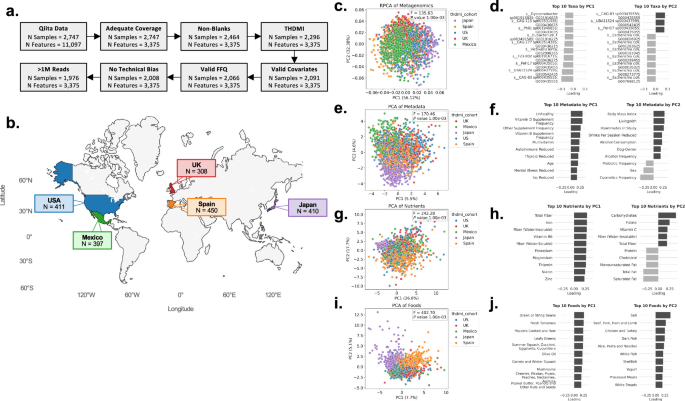
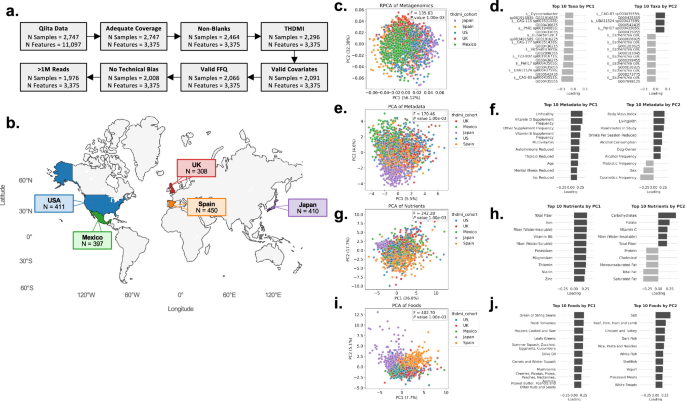
Fig. 1: Population characteristics.出典:原著論文「Five-country analysis of geographic and dietary drivers of gut microbiome composition and genomic variation」、Nature Communications(2026)。DOI: https://doi.org/10.1038/s41467-026-77928-9
Licensed under CC BY 4.0.
食事や生活習慣の違いは腸内細菌叢の構成や機能に影響するが、国際比較研究では調査方法の違いが結果の解釈を難しくしていた。本研究では、Human Diets and Microbiome Initiative(THDMI)に基づき、米国、英国、スペイン、メキシコ、日本の5か国から計1,976人を対象に、標準化された食事調査とショットガンメタゲノム解析を実施した。その結果、栄養素摂取量、食品消費パターン、腸内細菌叢の構成には国・地域による顕著な違いが認められ、食事と微生物叢の関連にも共通性と地域特異性の両方が存在することが示された。さらに、スパース正準相関分析と機械学習による解析から、食事と腸内細菌叢の関連は集団ごとの特徴が強く、ある国で得られた関連性を他国にそのまま適用することは難しいことが明らかになった。菌株レベルの解析でも、地域固有の食事や生態環境に対応する腸内細菌のゲノム構造の違いが確認された。一方、健康的な食事に対する共通の微生物学的応答も認められた。本研究は、腸内細菌叢と食事の関係を理解するうえで、地理的・文化的背景を考慮した個別化栄養学の重要性を示している。なお、本研究はDanone Nutricia Researchから研究資金の提供を受けている。
Diet and lifestyle vary considerably across populations and contribute to differences in gut microbiome composition and function. However, international comparisons have been limited by methodological heterogeneity. This study, conducted under the Human Diets and Microbiome Initiative (THDMI), investigated 1,976 participants from five countries: the United States, the United Kingdom, Spain, Mexico, and Japan. Standardized dietary assessments and shotgun metagenomic sequencing were used to examine relationships between dietary patterns and gut microbiome characteristics. The results revealed pronounced geographic differences in nutrient intake, food consumption, and microbial composition, with both shared and country-specific dietary associations. Sparse canonical correlation and machine-learning analyses further demonstrated that microbiome–diet relationships were largely population-specific, with limited generalizability across countries. Strain-level analyses also identified significant genomic differentiation among gut microbes, consistent with localized dietary and ecological differences. Nevertheless, common microbial responses to healthy dietary patterns were also observed. These findings highlight the importance of considering geographic, cultural, and dietary backgrounds when investigating the human gut microbiome and developing personalized nutrition strategies. The study was funded in part by Danone Nutricia Research.
原論文:Nature Communications,PubMed:PMID 42907460
