2026-11-19 ロックフェラー大学
<関連情報>
- https://www.rockefeller.edu/news/40421-brain-imaging-neuroscience-tools-algorithm/
- https://www.cell.com/cell-reports-methods/fulltext/S2667-2375(26)00346-2
大規模神経活動記録の時間的デコンボリューション
Temporal deconvolution of mesoscale recordings
Merav Stern, Eric Shea-Brown
Cell Reports Methods, Article 101645(2026年11月19日オンライン公開)
DOI:https://doi.org/10.1016/j.crmeth.2026.101645

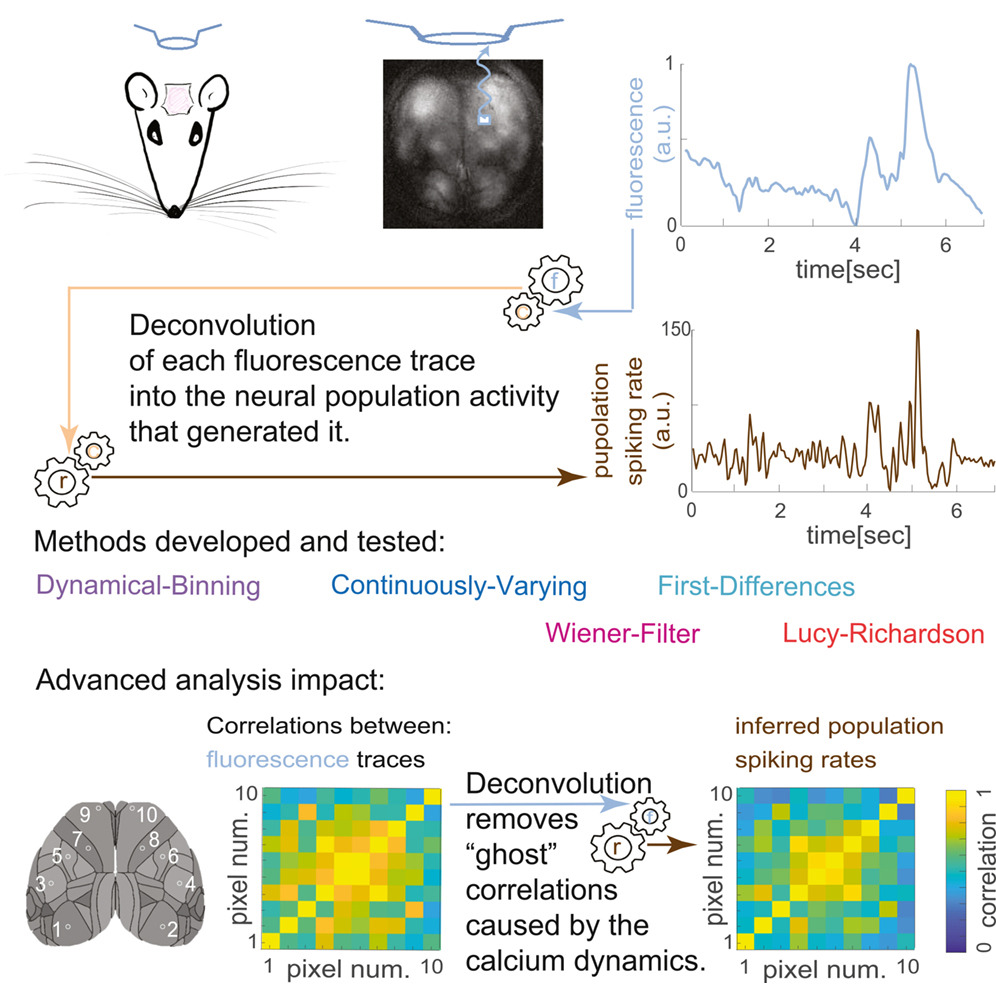
Graphical abstract © 2026 The Author(s). Published by Elsevier Inc. CC BY-NC 4.0
Wide-field calcium imaging enables neural activity to be recorded across extensive brain regions, but the fluorescence signals are temporally blurred by the calcium dynamics of the indicators. Consequently, the underlying time course of neuronal spiking cannot be directly recovered from raw fluorescence recordings. This study developed and evaluated four deconvolution methods to estimate neuronal firing rates from mesoscale fluorescence data: dynamically binning with adaptive time intervals, continuously varying rate estimation, a computationally efficient first-difference method, and a modified Wiener filter designed to accommodate large variations in fluorescence magnitude. All four approaches consistently outperformed the previously used adapted Lucy–Richardson algorithm on both synthetic datasets and simultaneous fluorescence-spike recordings. Importantly, the researchers demonstrated that using uncorrected fluorescence signals in advanced analyses can produce distorted results, including spuriously inflated correlations between brain regions. Such distortions arise because the temporal filtering of calcium signals introduces shared delays and smoothing into neural activity measurements. The proposed methods provide a framework for more accurately reconstructing the temporal structure of large-scale neuronal activity and improving the reliability of analyses of functional connectivity and brain-behavior relationships. They may be useful in wide-field calcium imaging, fiber photometry, and other neuroscience applications that rely on population-level fluorescence recordings.