2023-11-01 カリフォルニア大学バークレー校(UCB)
◆鞭毛虫のウイルス感染とSCTLDの関係に焦点を当てたこの研究は、ウイルスがサンゴ礁全体に広く存在し、SCTLDに特有の要因ではない可能性を示唆しています。サンゴ礁におけるウイルスと微生物がコロニーの健康や機能にどのように影響するかについての理解を深めるために、今後の研究が必要です。
<関連情報>
- https://nature.berkeley.edu/news/2023/10/tiny-agents-global-scale
- https://www.nature.com/articles/s41396-023-01526-6
サンゴの渦鞭毛藻には、属や海洋流域を問わず、糸状ウイルスのような粒子が存在する Filamentous virus-like particles are present in coral dinoflagellates across genera and ocean basins
Lauren I. Howe-Kerr,Anna M. Knochel,Matthew D. Meyer,Jordan A. Sims,Carly E. Karrick,Carsten G. B. Grupstra,Alex J. Veglia,Andrew R. Thurber,Rebecca L. Vega Thurber & Adrienne M. S. Correa
The ISME Journal Published:01 November 2023
DOI:https://doi.org/10.1038/s41396-023-01526-6
Abstract
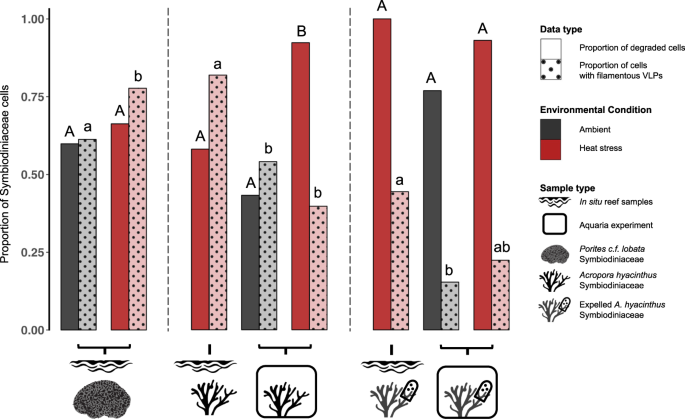
Filamentous viruses are hypothesized to play a role in stony coral tissue loss disease (SCTLD) through infection of the endosymbiotic dinoflagellates (Family Symbiodiniaceae) of corals. To evaluate this hypothesis, it is critical to understand the global distribution of filamentous virus infections across the genetic diversity of Symbiodiniaceae hosts. Using transmission electron microscopy, we demonstrate that filamentous virus-like particles (VLPs) are present in over 60% of Symbiodiniaceae cells (genus Cladocopium) within Pacific corals (Acropora hyacinthus, Porites c.f. lobata); these VLPs are more prevalent in Symbiodiniaceae of in situ colonies experiencing heat stress. Symbiodiniaceae expelled from A. hyacinthus also contain filamentous VLPs, and these cells are more degraded than their in hospite counterparts. Similar to VLPs reported from SCTLD-affected Caribbean reefs, VLPs range from ~150 to 1500 nm in length and 16–37 nm in diameter and appear to constitute various stages in a replication cycle. Finally, we demonstrate that SCTLD-affected corals containing filamentous VLPs are dominated by diverse Symbiodiniaceae lineages from the genera Breviolum, Cladocopium, and Durusdinium. Although this study cannot definitively confirm or refute the role of filamentous VLPs in SCTLD, it demonstrates that filamentous VLPs are not solely observed in SCTLD-affected corals or reef regions, nor are they solely associated with corals dominated by members of a particular Symbiodiniaceae genus. We hypothesize that filamentous viruses are a widespread, common group that infects Symbiodiniaceae. Genomic characterization of these viruses and empirical tests of the impacts of filamentous virus infection on Symbiodiniaceae and coral colonies should be prioritized.