
2026-02-05 カリフォルニア大学サンディエゴ校(UCSD)
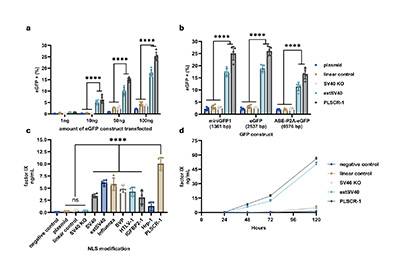
Graph a shows 10 nanograms of unmodified, non-nuclear-targeted DNA with almost no signal, while the nuclear-targeted DNA shows greater than 10x the expression. Graph c shows the efficacy of DNA-NLS conjugates in epressing Factor IX protein.
<関連情報>
- https://today.ucsd.edu/story/from-cytoplasm-to-nucleus
- https://www.nature.com/articles/s41467-025-68167-5
増殖停止細胞におけるDNAペプチド複合体の高効率発現 Highly efficient expression of DNA-peptide conjugates in growth-arrested cells
Zulfiqar Y. Mohamedshah,Chih-Chin Chi,Ember M. Tota,Alexis C. Komor & Neal K. Devaraj
Nature Communications Published:07 January 2026
DOI:https://doi.org/10.1038/s41467-025-68167-5 An unedited version of this manuscript
Abstract
Efficient nuclear delivery of DNA remains a major challenge in non-viral gene therapy. While nuclear localization signal (NLS) peptides have been explored for enhancing nuclear translocation of DNA, their efficacy has been limited by DNA-peptide conjugation strategies. Leveraging E. coli tRNA guanine transglycosylase, we present a modular workflow for generating DNA oligonucleotide-peptide conjugates which are ligated to linear DNA to generate peptide-modified gene cassettes (DNA-PepTAG). Using an eGFP reporter delivered via lipofection to growth-arrested cells, NLS-modified gene cassettes significantly increases nuclear localization, mRNA transcription, and expression up to ~10 fold compared to unmodified gene cassettes. Screening multiple NLS peptides in growth-arrested human cell lines reveal cell-type-specific preferences for nuclear translocation of DNA cargo. Two NLS peptides, PLSCR-1 and extSV40, exhibit consistently high expression across tested cell types, indicating broad applicability for nuclear delivery. We evaluate the generality of our approach by delivering DNA payloads encoding for both cytosolic and secreted proteins, as well as gene cassettes ranging in size from 1.3 kbp to 7 kbp. These findings support the potential of DNA-NLS conjugates as a viable strategy for non-viral gene therapy, enabling enhanced nuclear delivery of therapeutic genes while minimizing the required DNA dose.

