2026-02-16 カロリンスカ研究所(KI)
<関連情報>
- https://news.ki.se/early-life-gut-bacteria-exposures-may-protect-children-against-allergies
- https://www.nature.com/articles/s41564-025-02244-9
芳香性乳酸産生ビフィズス菌による幼少期の定着はアレルギー感作のリスクを低下させる Early-life colonization by aromatic-lactate-producing bifidobacteria lowers the risk of allergic sensitization
Pernille Neve Myers,Rasmus Kaae Dehli,Axel Mie,Janne Marie Moll,Henrik Munch Roager,Carsten Eriksen,Martin Frederik Laursen,Ellen Magdalena Staudinger,Ioanna Chatzigiannidou,Pi Lærke Johansen,Niels van Best,Martin O’Hely,Daniel Andersen,Nadja Lund Nørregaard,Mikael Pedersen,Eckard Hamelmann,Susanne Lau,Martin Iain Bahl,Maher Abou Hachem,Tine Rask Licht,Henrik Bjørn Nielsen,Anna Hammerich Thysen,Peter Vuillermin,John Penders,… Susanne Brix
Nature Microbiology Published:12 January 2026
DOI:https://doi.org/10.1038/s41564-025-02244-9
Abstract
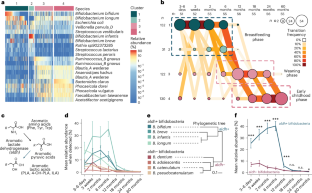
Early-life microbial exposures shape immune development and allergy risk. Food allergen sensitization, reflected by the presence of food allergen-specific immunoglobulin E (IgE), is an early indication of impaired immune tolerance. Here we show that early-life transmission of aromatic lactate-producing bifidobacteria strains in 147 children followed from birth to 5 years of age, facilitated by vaginal delivery, exposure to older siblings and exclusive breastfeeding for the first 2 months, led to increased levels of aromatic lactates in the infant gut. This microbiota–metabolite signature was inversely associated with the development of food allergen-specific IgE until 5 years and atopic dermatitis at 2 years. The observed effect was mediated by 4-hydroxy-phenyllactate, which inhibited IgE, but not IgG, production in ex vivo human immune cell cultures. Together, these findings define an early-life microbiota–metabolite–immune axis linking microbial transmission and feeding practices with reduced allergic sensitization.