2026-03-03 中国科学院(CAS)
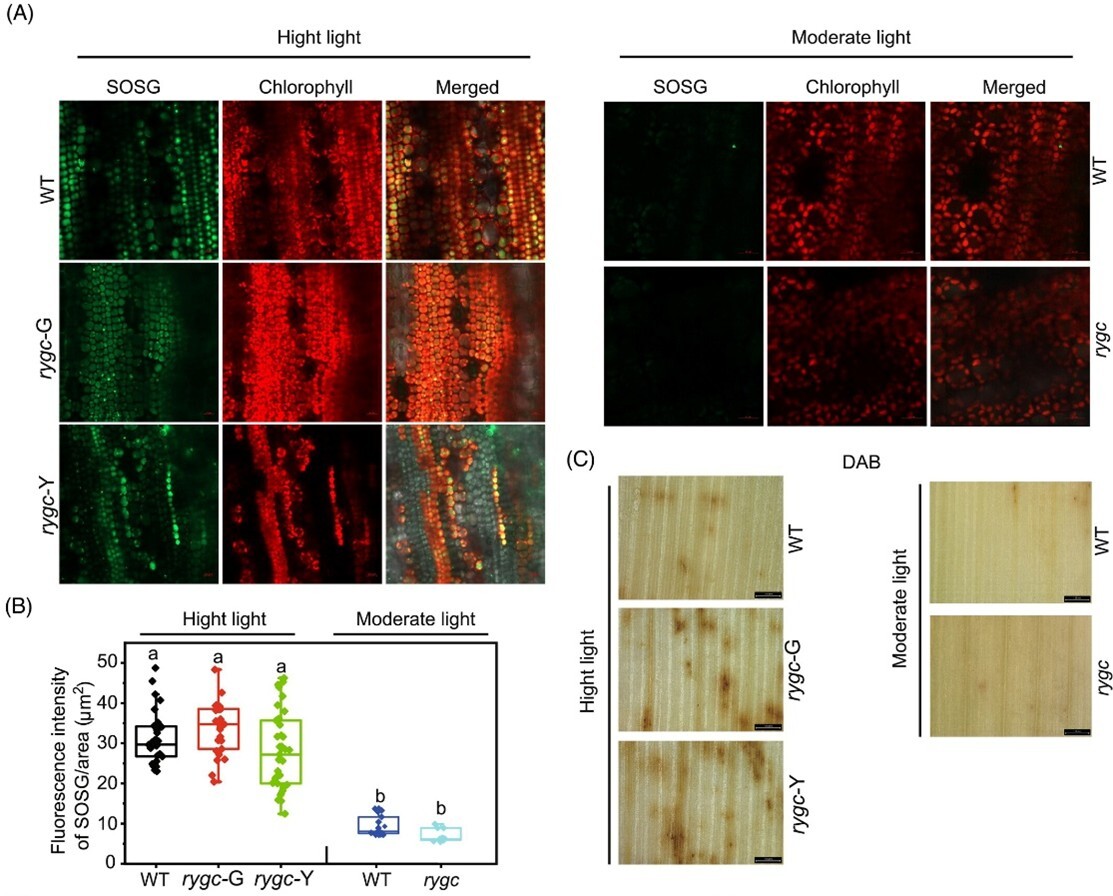
Accumulation of reactive oxygen species in the mutant under different light conditions (Image by CHAO Qing)
<関連情報>
- https://english.cas.cn/newsroom/research-news/202603/t20260310_1152349.shtml
- https://www.cell.com/plant-communications/fulltext/S2590-3462(26)00042-8
ZmPEPCK2は、トウモロコシ穀粒の炭素と窒素の代謝を同期させることで、栄養価と収量ポテンシャルを高めます ZmPEPCK2 enhances nutritional quality and yield potential by synchronizing carbon and nitrogen metabolism in maize kernels
Xiu Yang ∙ Qing Chao ∙ Zhi-Fang Gao ∙ … ∙ Xiao-Hui Li ∙ Li-Jin Tian ∙ Bai-Chen Wang
Plant Communications Published:January 21, 2026
DOI:https://doi.org/10.1016/j.xplc.2026.101734
Abstract
Maize (Zea mays) is the world’s third most important staple crop and a major source of dietary energy and protein. Carbon and nitrogen accumulation in developing kernels fundamentally determine grain quality, influencing both nutritional value and processing characteristics. However, increasing kernel nitrogen content without compromising yield remains a major challenge in maize breeding. Here, we show that phosphoenolpyruvate carboxykinase 2 (PEPCK2) functions as a key regulator of nitrogen sink strength, with its maternal expression level determining carbon and nitrogen accumulation in progeny kernels. Genetic analyses revealed that natural variation in both the promoter and coding regions of PEPCK2 is strongly associated with yield- and quality-related traits. Through genetic manipulation, we demonstrate that PEPCK2 overexpression increases ear length by 18.7%, kernel weight by 22.3%, and protein content by 31.5%, whereas knockdown reduces these parameters by 15.2%–21.4% without affecting vegetative growth. Biochemical analyses show that PEPCK2 catalyzes the conversion of oxaloacetate to phosphoenolpyruvate, enhances flux through the tricarboxylic acid cycle by 2.3-fold, and promotes the efficient conversion of amino acid carbon skeletons into starch while recycling nitrogen for protein synthesis. Together, these findings establish PEPCK2 as a master regulator that simultaneously enhances maize nutritional quality and yield potential. The apparent conservation of this carbon–nitrogen coordination mechanism highlights its promise for improving cereal crops through targeted metabolic engineering.