
2026-03-12 ジョンズ・ホプキンス大学(JHU)
<関連情報>
- https://hub.jhu.edu/2026/03/12/crops-store-pharmaceutical-byproducts-in-leaves/
- https://pubs.acs.org/doi/10.1021/acs.est.5c14903
食用作物における廃水由来向精神薬の蓄積と代謝 Accumulation and Metabolism of Wastewater-Derived Psychoactive Pharmaceuticals in Edible Crop Plants
Daniella A. H. Sanchez,and Carsten Prasse
Environmental Science & Technology Published: March 12, 2026
DOI:https://doi.org/10.1021/acs.est.5c14903
Abstract
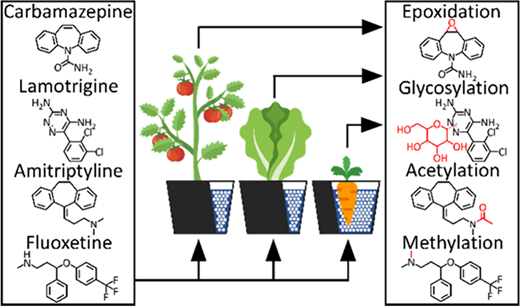
Reclaimed wastewater is increasingly used for agricultural irrigation to reduce global freshwater demand, raising concerns about potential human exposure to organic contaminants that are taken up by plants. While previous research has demonstrated that plants can take up and metabolize anthropogenic organic contaminants, such as pharmaceuticals, there is a lack of understanding about plant-specific differences. To address this knowledge gap, semihydroponically grown lettuce, tomatoes, and carrots were exposed to four psychoactive pharmaceuticals─carbamazepine (CBZ), lamotrigine (LTG), amitriptyline (AMI), and fluoxetine (FLX)─for 28, 45, and 15 days, respectively. The highest pharmaceutical concentrations were observed in leaf tissues, whereas concentrations in the edible portions of carrots and tomatoes were approximately 7-fold and 220-fold lower than those in their respective leaf tissues. Across the various plant tissues, CBZ and AMI were generally accumulated more than LTG and FLX. Liquid chromatography–high-resolution mass spectrometry analysis revealed 15, 7, 38, and 27 metabolites of CBZ, LTG, AMI, and FLX, respectively, including 15 novel in planta metabolites, among which were N-acylation products of the amine-containing LTG, AMI, and FLX. Similar metabolic pathways were observed across the three plant types, with the detection of more complex metabolites tied to higher tissue concentrations of parent compounds rather than to species specificity.

