20026-05-07 ウースター工科大学(WPI)
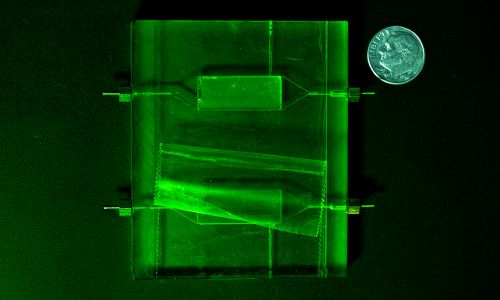
An experimental microfluidic device containing two rectangular polymers coated with phages and covered with a biocompatible plastic tape was used in the research team’s experiments.
<関連情報>
- https://www.wpi.edu/news/building-biosensor-detect-harmful-bacteria
- https://pubs.acs.org/doi/10.1021/acsabm.5c01652
ファージを搭載したマイクロ流体デバイスによる選択的細菌検出:現場での応用における高い可能性 Phage-Loaded Microfluidic Device for Selective Bacterium Detection with a High Potential for in-the-Field Applications
Hamed Ghavami,Christopher R. Lambert,Jessica Drozd,and Yuxiang Liu
ACS Applied Bio Materials Published: April 14, 2026
DOI:https://doi.org/10.1021/acsabm.5c01652
Abstract
Detection of foodborne bacteria is critical because these pathogens cause foodborne outbreaks, which is a major public health concern worldwide. Conventional microbiological methods include plating and colony counting, molecular techniques such as polymerase chain reaction (PCR), and enzyme-linked immunosorbent assays (ELISA). These methods can be quite sensitive and specific, but they are also slow, require labor work, and often involve complex sample preparation. These limitations drive the development of faster and point-of-use detection techniques. In this study, we present a microfluidic biosensor platform based on P22 bacteriophage-loaded PDMS surfaces for rapid detection of Salmonella enterica. The PDMS surface had microscale topographical roughness, which helps improve immobilized phage concentration and promotes their capabilities to capture target bacteria. The system allows rapid bacteria detection with an experimentally demonstrated limit of detection of 9.15 × 10³ cells/mL and a demonstrated specificity for Salmonella enterica over Staphylococcus aureus employed as a non-target control. Such detection was achieved under continuous flow conditions without the need of incubation, which implies its high potential for in-field applications and in resource-limited locations. This work demonstrates a rapid and selective approach for bacterial detection with strong potential for real-world food and water safety applications.
00114-3/asset/e10b49ee-16c5-4125-910e-bed9955be343/main.assets/gr1_lrg.jpg "結核リスクのスクリーニングと予測に向けた新手法 (Tuberculosis Risk: Promising Approaches for Screening and Prediction)")