2026-03-17 中国科学院(CAS)
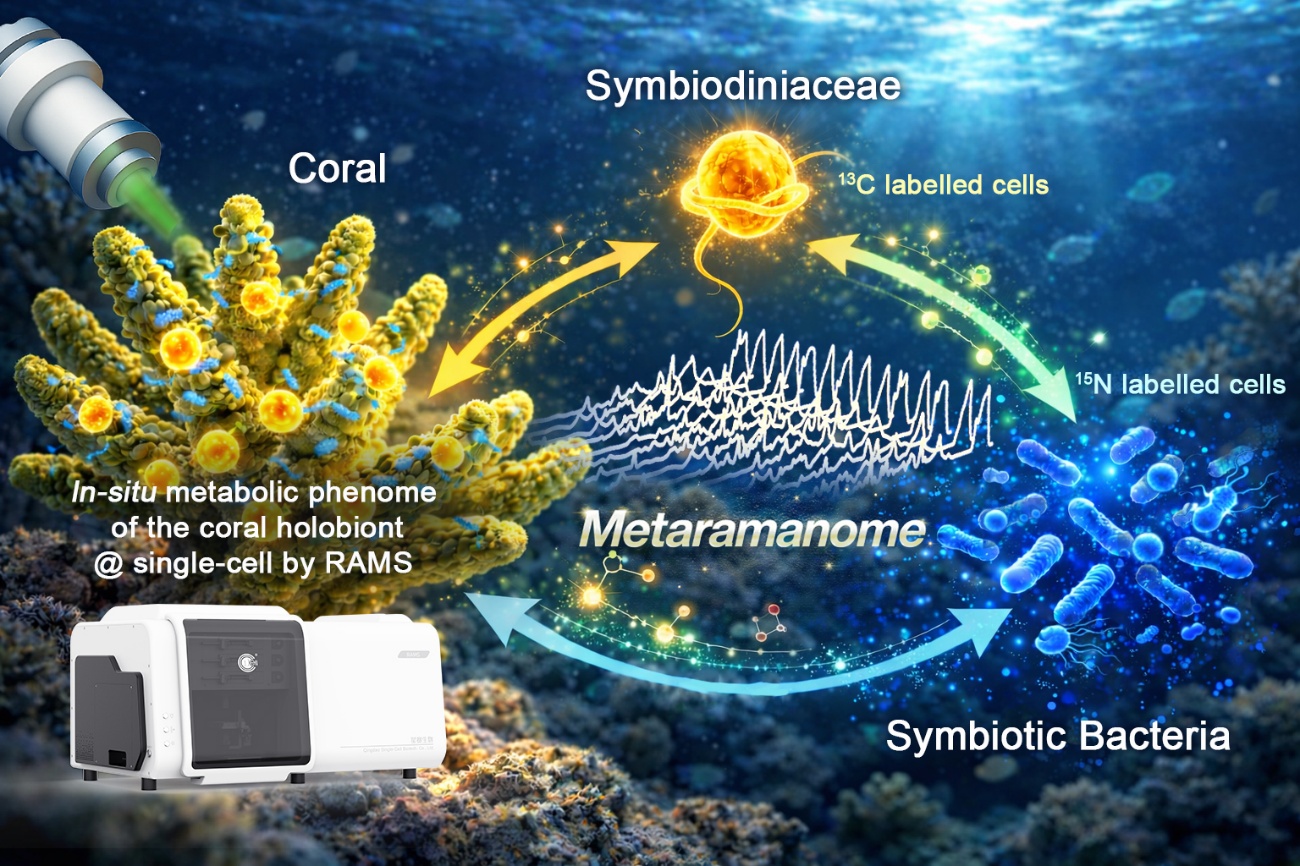
Metaramanome enables a deeper understanding of metabolic interactions within coral-Symbiodiniaceae-bacteria relationships (Image by WANG Xiaohang)
<関連情報>
- https://english.cas.cn/newsroom/research-news/202603/t20260317_1152808.shtml
- https://link.springer.com/article/10.1186/s40168-026-02338-4
単一細胞ラマン分光メタボロミクスによるサンゴホロビオントの再構築と、共生細菌、細菌、サンゴ間の因果関係の解明 Reconstruction of coral holobionts and elucidation of the causal relationships among symbiodiniaceae, bacteria, and coral through single-cell raman spectroscopy metabolomics
Yang Shu,Yuehui He,Tianhui Chen,Yuanyuan Zhou,Yawen Liu,Pengcheng Fu &Jian Xu
Microbiome Published:27 February 2026
DOI:https://doi.org/10.1186/s40168-026-02338-4 Unedited version
Abstract
Background
The global decline of coral reefs underscores the urgency of understanding how corals enhance resilience in stressful environmental conditions. As metaorganisms, or holobionts, corals rely on dynamic interactions with their associated microbial communities, with bacterial restructuring proposed as a potential mechanism of holobiont adaptation. Here, we reconstructed coral symbiosis in the bleached tissues of Acropora hyacinthus by introducing beneficial bacteria and thermally domesticated Symbiodiniaceae to assess their roles in bleaching recovery. Raman spectroscopy metabolomics (RS metabolomics) enables in situ detection, providing temporal evidence of metabolic exchange within the tripartite relationship among corals, Symbiodiniaceae, and associated bacteria.
Results
This study highlights the potential of acclimation-based approaches in the development of thermotolerant Symbiodiniaceae strains. Furthermore, by manipulating this bacterial community, we identified a bacterium that enhances the thermal and light tolerances of acclimated Symbiodiniaceae, offering new insights into coral reef homeostasis strategies. Our results also indicate that the introduction of beneficial bacterial strains and thermotolerant Symbiodiniaceae, including proteins, lipids, and carbohydrates, increased nutrient levels in the coral host.
Conclusions
This work introduces a microbial-assisted holobiont reconstitution framework that advances understanding of cross-kingdom metabolic integration and offers a mechanistic basis for engineering coral resilience under climate stress. The findings could provide insights into leveraging beneficial microbiota to mitigate thermal-induced coral bleaching, ultimately informing conservation strategies for marine ecosystems.