2026-03-19 東京科学大学
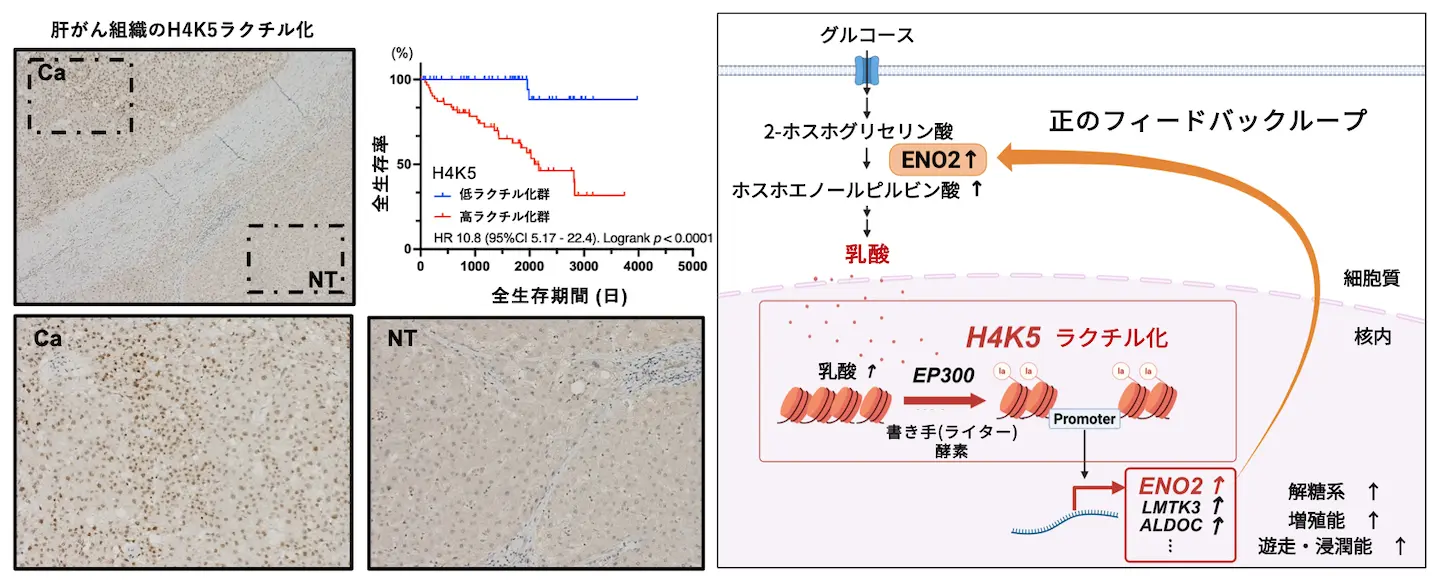
図1. ヒストンH4K5ラクチル化異常による肝がんの悪性化メカニズム
<関連情報>
- https://www.isct.ac.jp/ja/news/fvx0fpvsxuxo
- https://www.jhep-reports.eu/article/S2589-5559(26)00057-1/fulltext
H4K5乳化 – ENO2ループが解糖系と肝細胞癌の進行を促進する H4K5 Lactylation – ENO2 Loop Drives Glycolysis and HCC Progression
Masahiro Yamane ∙ Yoshimitsu Akiyama y ∙ Shu Shimada ∙ … ∙ Kenichi Ohashi ∙ Daisuke Ban ∙ Shinji Tanaka
JHEP Reports Published:February 18, 2026
DOI:https://doi.org/10.1016/j.jhepr.2026.101786
Highlights
- Elevated H4K5la levels are associated with poor prognosis in patients with HCC.
- H4K5la promotes HCC progression by epigenetically activating tumor-promoting genes.
- A positive feedback loop of ENO2-H4K5la contributes to HCC progression.
- The H4K5la-ENO2 pathway is a promising therapeutic target for HCC.
Abstract
Background & Aims
Histone lactylation is a lactate-dependent epigenetic modification driven by glycolysis. Although elevated histone lactylation occurs in various cancers, the biological relevance of histone H4 lactylation in hepatocellular carcinoma (HCC) remains unclear. The aim of this study is to investigate the clinicopathological relevance of histone H4 lysine 5 lactylation (H4K5la) and its role in regulating lactate metabolism to promote HCC progression.
Methods
H4K5la, H3K18la, and panKla expression levels were evaluated by immunohistochemistry in HCC tissues (n = 104). RNA-seq and ChIP-qPCR analyses were performed in HCC cells treated with lactate to identify downstream target genes regulated by H4K5la. Functional validation of these targets was conducted using knockdown and overexpression experiments, and biological effects were assessed in vitro and in vivo.
Results
Elevated H4K5la, H3K18la, and panKla levels were associated with poor prognosis, and H4K5la was identified as an independent prognostic factor of overall survival (p = 0.0064). Upon lactate treatment, four genes including the glycolytic enzyme enolase 2 (ENO2) were identified in three HCC cell lines, showing enrichment of H4K5la in their promoter regions. ENO2 knockdown reduced intracellular lactate and H4K5la levels, and in vivo tumorigenicity in HCC cells (p < 0.001), whereas ENO2 overexpression exerted the opposite effects. These findings indicated a positive feedback loop: H4K5la increased ENO2 expression, which in turn amplified glycolysis and lactate production, further elevating H4K5la levels. Moreover, ENO2 expression closely correlated with H4K5la levels in HCC tissues.
Conclusions
High histone H4K5la serves as an independent prognostic biomarker in HCC and promotes tumor progression via a positive feedback loop with ENO2. Targeting this H4K5la-ENO2 axis may represent a novel therapeutic strategy for HCC patients with the hyper-lactylation phenotype.
Impact and implications
Despite limited understanding of the role of histone H4 lactylation in cancer, this study identifies H4K5la as a critical epigenetic regulator of HCC progression. Lactate-induced elevation of H4K5la enhances ENO2 expression, which in turn increases H4K5la levels, establishing a positive H4K5la–ENO2 feedback loop in HCC. These data highlight that elevated H4K5la and ENO2 expression are potential prognostic biomarkers and therapeutic targets in patients with HCC.