2026-07-06 東京大学
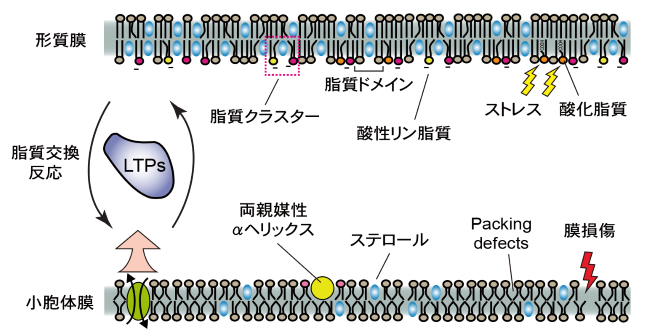
図1 生体膜の膜脂質環境は多様である
<関連情報>
細胞表面リポソーム結合(CLiB)により、ハイスループットスクリーニングを介した脂質結合プローブの設計が可能になる Cell surface liposome binding (CLiB) allows lipid-binding probe engineering via high-throughput screening
Taki Nishimura,Kotaro Tsuboyama,Yuki Nakagaki,Shiou-Ling Lu,Yuki Ishino,Nozomu Kono,Takeshi Noda,Eiji Yamamoto & Noboru Mizushima
Nature Cell Biology Published:02 July 2026
DOI:https://doi.org/10.1038/s41556-026-01996-8
Abstract
Lipid-binding domains, traditionally isolated from natural proteins, are essential tools for probing membrane lipid dynamics and specialized cellular compartments. Despite diverse applications, a general strategy for their engineering remains elusive. Here we present a robust and high-throughput method for monitoring protein–lipid interactions, named the cell surface liposome binding (CLiB) assay. Using the assay, we conducted directed evolution of the PX domain from SnxA, isolating high-affinity variants specific for phosphatidylinositol 3,5-bisphosphate (PI(3,5)P2). Combining the CLiB assay with next-generation sequencing enabled parallel analysis of >6,000 clones, comprehensively identifying key residues critical for lipid binding. An engineered variant, PX-SnxAGV, functioned as a lipid biosensor in yeast and mammalian cells, visualizing PI(3,5)P2-enriched membrane subdomains upon hyperosmotic shock and during microautophagy, thereby suggesting localized PI(3,5)P2 synthesis within spatially restricted regions. This study provides a framework for on-demand generation of lipid-binding probes, facilitating the discovery of membrane compartments characterized by unique lipid compositions.