2026-03-27 東北大学
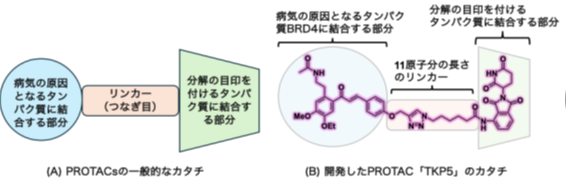
図1. 一般的なPROTACsと開発したTKP-5のカタチ
<関連情報>
- https://www.tohoku.ac.jp/japanese/2026/03/press20260327-02-PROTAC.html
- https://www.tohoku.ac.jp/japanese/newimg/pressimg/tohokuuniv-press20260327_02web_protac.pdf
- https://pubs.acs.org/doi/10.1021/acs.jmedchem.5c03771
アルキン二段階戦略:BRD4分解剤としてのTK-285由来PROTACの迅速な生成 Alkyne Two-Phase Strategy: Rapid Generation of TK-285-Derived PROTACs as BRD4 Degraders
Hiroyuki Yamakoshi,Ryo Watanabe,Ryosuke Segawa,Ryosuke Ishihara,Ryo Tachibana,Genki Kudo,Shota Nagasawa,Satoshi Yamanaka,Ayano Ito,Hiroyuki Takeda,Tatsuya Sawasaki,Ryunosuke Yoshino,Takatsugu Hirokawa,Takayuki Doi,Noriyasu Hirasawa,and Yoshiharu Iwabuchi
Journal of Medicinal Chemistry Published: March 19, 2026
DOI:https://doi.org/10.1021/acs.jmedchem.5c03771
Abstract
This study introduces a divergent synthetic strategy in linkerology using preassembled linkers to generate structural diversity. The approach was validated by developing bromodomain-containing protein 4 (BRD4)–targeting proteolysis-targeting chimeras (PROTACs) based on an “alkyne two-phase strategy,” employing the BRD4 inhibitor TK-285 as the binding ligand. In the initial screening phase, alkyne-modified TK-285 derivatives were subjected to click chemistry to optimize linker length and the modification site, leading to the identification of TKP-5 as a potent degrader. TKP-5 exhibited stronger thymic stromal lymphopoietin─more suppressive activity than TK-285 and markedly suppressed IL-33 mRNA expression in a tape-stripping-induced skin injury model. In the subsequent optimization phase, late-stage diversification using 1,3-butadiyne-typed PROTAC intermediates revealed the critical contribution of the triazole moiety, supported by in silico analysis suggesting interaction with Trp81 of BRD4. The strategy is expected to be broadly applicable to modular functional molecules accessible via click chemistry.