2026-04-03 東京大学,千葉大学,科学技術振興機構
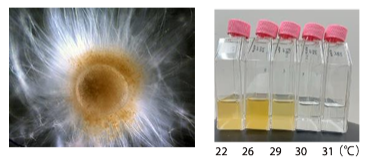
32℃でも元気な光共生系(左)と29℃までしか成長できない単離共生藻(右)
<関連情報>
- https://www.jst.go.jp/pr/announce/20260403-2/index.html
- https://www.jst.go.jp/pr/announce/20260403-2/pdf/20260403-2.pdf
- https://link.springer.com/article/10.1007/s13199-026-01122-0
光合成共生と耐熱性:浮遊性有孔虫とその渦鞭毛藻類からの知見 Photosymbiosis and thermal tolerance: Insights from planktonic foraminifera and their dinoflagellates
Haruka Takagi & Shin Sekine
Symbiosis Published:31 March 2026
DOI:https://doi.org/10.1007/s13199-026-01122-0
Abstract
The thermal tolerance of marine organisms is a key factor governing their survival under future ocean warming. Especially, the responses of complex systems like photosymbiotic consortia are difficult to predict, yet need to be assessed to get further insight of marine ecosystem changes. In this study, we experimentally assessed the upper temperature limit of the planktonic foraminifera Trilobatus sacculifer and its algal symbiont Pelagodinium béii. Our results demonstrated that T. sacculifer remains healthy and reproductively active at 32 °C, but fails to grow, capture prey, and release gametes at 34 °C. The results suggest the upper threshold is between 32 °C and 34 °C, which is largely in agreement with previous reports. Photophysiological parameters of in hospite symbiont were stable up to 32 °C, but declined sharply at 34 °C without bleaching, emphasizing a narrow tolerance window. On the other hand, free-living P. béii, originally extracted from T. sacculifer, exhibited a lower upper temperature limit (29 °C). Additional experiments on P. béii could demonstrate that the limit could be elevated to 30 °C only when the light intensity was lowered. In hospite P. béii sequestered by foraminifera could tolerate higher temperatures; this is likely partly related to host-mediated shading and cell clustering (self-shading) effects that mitigate combined heat and light stress. However, the shading effects did not work above 30 °C, suggesting an unresolved mechanism enabling in hospite population to cope with 32 °C. Nevertheless, these findings highlight that photosymbiosis provides not only nutritional exchange but also protection against environmental extremes for symbionts. Such elevation of fitness in the algae in hospite would contribute to enhancing the fitness of the host, thus providing important implications for the resilience of symbiotic foraminifera under projected ocean warming scenarios.