2026-04-07 ジョージア工科大学
<関連情報>
- https://research.gatech.edu/georgia-tech-researchers-develop-first-genetic-passcode-lock-protect-valuable-dna
- https://www.science.org/doi/10.1126/sciadv.aeb8556
遺伝子レベルで細胞を保護し、バイオハッカソンを通じて不正アクセスをシミュレートする Protecting cells at the genetic level and simulating unauthorized access via a biohackathon
Dowan Kim, Ishita Kumar, Mohamed I. Hassan, Luisa F. Barraza-Vergara, […] , and Corey J. Wilson
Science Advances Published:1 Apr 2026
DOI:https://doi.org/10.1126/sciadv.aeb8556
Abstract
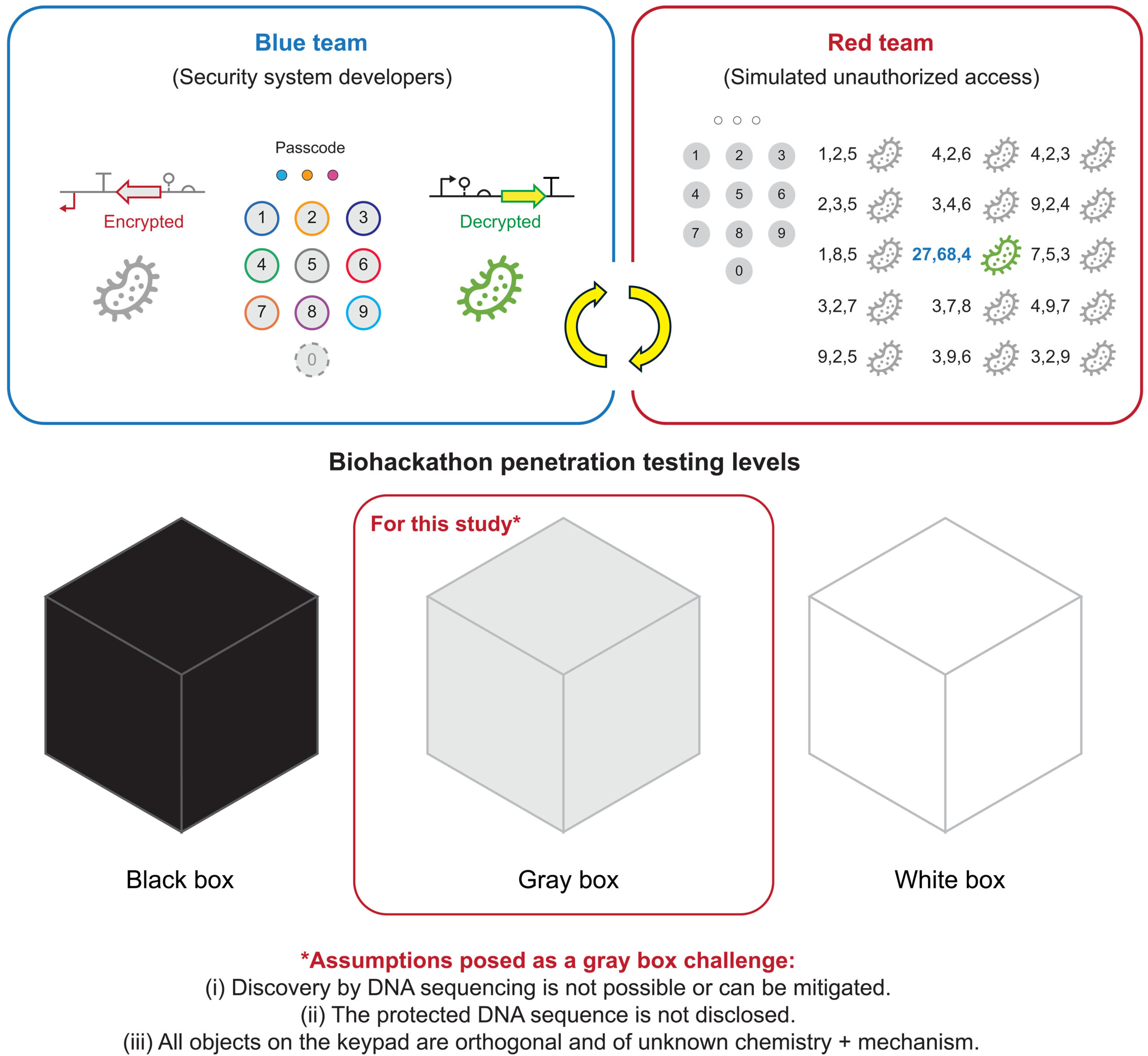
The protection of high-value cell lines (assets) relies on physical security by limiting access to samples. We present a cybersecurity-inspired platform that protects biological assets at the genetic level. This technology uses a permutation lock design where an asset can only be decrypted using an authentication code r from a search space composed of n objects on a defined keypad. Here, the genetic asset is designed as a scrambled DNA sequence, and the code is a temporal pattern of small molecules that regulate sets of recombinases that can unscramble a DNA sequence into the desired final sequence. In this work, a “blue team” designed and built an encrypted (scrambled) DNA sequence, and a “red team” sought to break the code through an ethical hacking exercise. Two iterations of testing revealed a 0.2% (2 in 990) chance of gaining access to the asset by random search, which is on par with the theoretical goal of 0.1% (1 in 990).