2026-04-09 成育医療研究センター
<関連情報>
日本における出生前遺伝子検査の20年間の動向 Two-decade trends in prenatal genetic testing in Japan
Aiko Sasaki,Takahiro Yamada,Haruhiko Sago,Nahoko Shirato,Akihiko Sekizawa,Kenichiro Hata,Hideaki Masuzaki,Yuko Masuzawa,Toshiyuki Yamamoto,Hiroshi Yoshihashi,Shiro Tanaka,Yuka Shibata,Kanako Koike Fukushima,Kenjiro Kosaki,Shigehito Yamada,Masakazu Nishigaki,Ikuo Konishi & Hidehiko Miyake
Journal of Human Genetics Published:02 March 2026
DOI:https://doi.org/10.1038/s10038-026-01465-y
Abstract
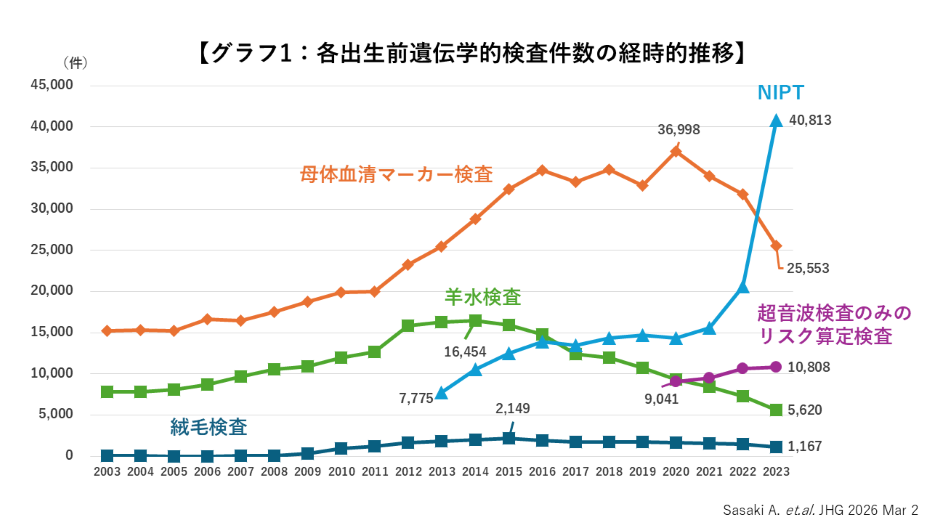
Prenatal genetic testing in Japan has undergone major changes over the past 2 decades. Maternal serum screening (MSS), amniocentesis (AC), and chorionic villus sampling (CVS) have been the principal tools used to identify fetal chromosomal abnormalities. Recently, non-invasive prenatal testing (NIPT) has reshaped clinical decision-making. However, updated national-level data capturing trends in conventional prenatal testing methods are limited. We aimed to assess the current landscape of prenatal genetic testing in Japan. To update the national data, we compiled test volumes from five major high-volume laboratories that analysed prenatal genetic tests and conducted a supplemental nationwide questionnaire-based survey on ultrasound (US)-only screening between 2020 and 2023. Over this period, MSS declined from 34,887 cases in 2018 to 25,553 in 2023, AC from 16,454 in 2014 to 5620 in 2023, and CVS from 2149 in 2015 to 1167 in 2023, whereas US-only screening increased slightly to >10,000 cases annually. The chromosomal abnormality detection rate among AC cases increased from 8% during 2006–2014 to 20.0% in 2023, with trisomy 21 comprising 43.6% of the cases. During the same period, the proportion of mothers aged ≥35 years increased from 14.0% in 2003 to 30.4% in 2023, whereas the proportion of national live births decreased by 35.3%. Thus, declining test volumes cannot be attributed solely to demographic changes but also reflect the influence of NIPT uptake, improved pretest risk stratification, and changing reproductive decision-making supported by expanding genetic counselling. This study provides foundational data for future prenatal genetic testing practices and policies in Japan.