2026-04-13 京都大学
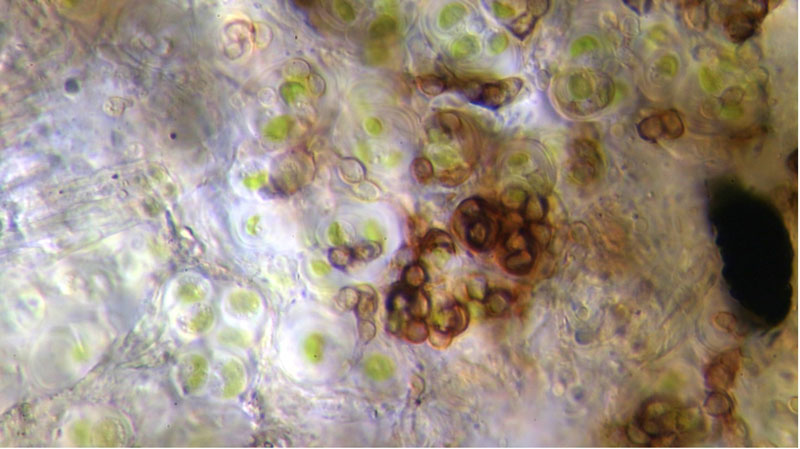
単細胞緑藻類の細胞外多糖からなるゼラチン状のコロニーの内部で子嚢菌Tschermakia inclusaが単細胞緑藻類に接触している様子。(撮影者:森山貴登)
<関連情報>
- https://www.kyoto-u.ac.jp/ja/research-news/2026-04-13-0
- https://www.kyoto-u.ac.jp/sites/default/files/2026-04/web_2604_Tanaka-7834a942df0aa9d5b983f258a021d3d2.pdf
- https://www.sciencedirect.com/science/article/abs/pii/S1878614626000425
84年ぶりに「Gloeocystis -Halbflechte」が再発見され、ゼラチン状の藻類バイオフィルムに生息する独立した子嚢菌類の系統が明らかになった Rediscovery of “Gloeocystis-Halbflechte” after 84 years revealed an independent lineage of ascomycetes harboured in gelatinous algal biofilms
Takato Moriyama, Chiharu Endo, Yuji Isagi, Chihiro Tanaka, Moriya Ohkuma, Akira Hashimoto
Fungal Biology Available online: 31 March 2026
DOI:https://doi.org/10.1016/j.funbio.2026.101757
Highlights
- A novel and independent algae-associate lineage from gelatinous algal biofilms is described as a new family, genus, and species.
- The developmental stage of thallus resembled an undescribed algae-associated fungus reported in 1941.
- The photobiont is a close relative of Radiococcus signiensis.
Abstract
Gloeocystis-Halbflechte refers to a variant of the interactive structure between fungi and terrestrial unicellular green algae in which fungi form haustoria in algal cells within gelatinous algal colonies and occasionally form monilioid hyphal outgrowth. It was first recognized in 1941; however, the identity of the fungal and algal components of this interaction has not been clarified. In this study, the interactive structure between fungi and algae resembling Gloeocystis-Halbflechte and the adjacent pycnidia formed within terrestrial gelatinous algal biofilms were collected in Japan. Fungal isolates from monilioid pigmented hyphae around haustoria and pycnidial wall were found to be genetically homogenous. Phylogenetic analysis of the fungal isolates suggested their affinity with the order of freshwater saprobic fungi Natipusillales, and formation of chlamydospore-like body under pure culture was shared with this family. Based on the genetic, ecological, and morphological independency, a new family, Tschermakiaceae, is proposed to accommodate a new genus and species, Tschermakia inclusa. It is highly possible that the fungi-algae interaction in Tschermakia has been acquired independently from other lichenized lineages as this order is independent from any other lichenized lineage. The algal isolate from the biofilm was grouped with the ex-type strain of Radiococcus signiensis (Prasiolales incertae sedis), and the morphology of the algae associated with the fungal hyphae in natural conditions was consistent with that of R. signiensis. Furthermore, the fungal isolate formed haustoria in the algal isolate in co-cultural experimental conditions. The evolutionary background and phylogenetic diversity of algae-symbiotic fungi are probably still underestimated.