2026-04-23 神戸大学
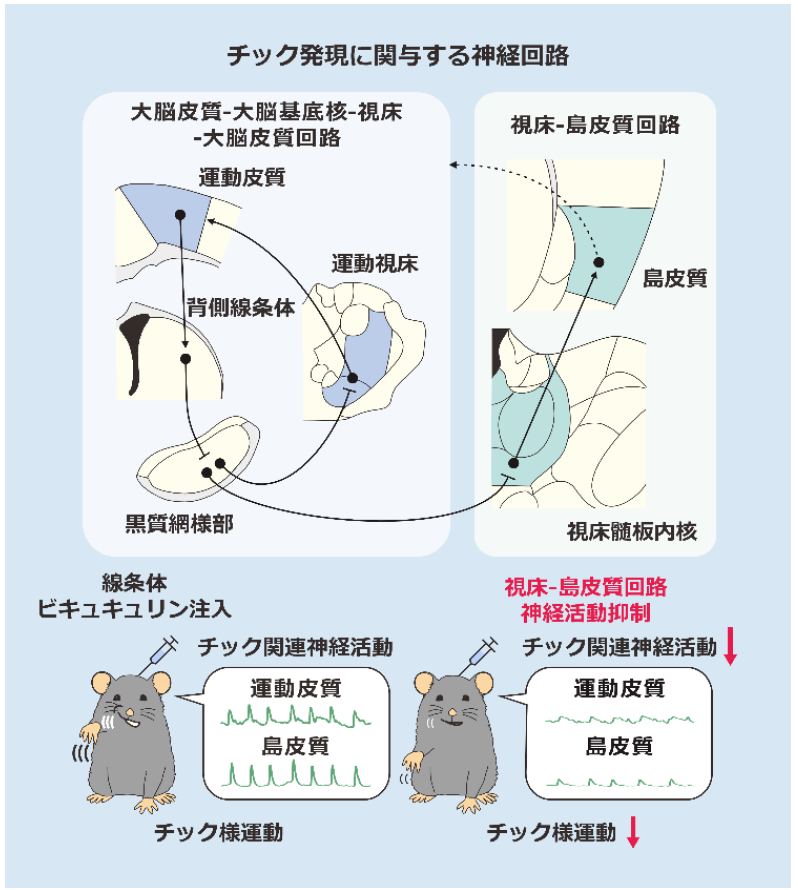
研究の概要図
©Cell Reports (2026) (DOI: 10.1016/j.celrep.2026.117272) (CC BY 4.0)
<関連情報>
- https://www.kobe-u.ac.jp/ja/news/article/20260423-67758/
- https://www.cell.com/cell-reports/fulltext/S2211-1247(26)00350-5
視床髄板内層は基底核からの出力を島皮質に中継し、チックの発生を促す Intralaminar thalamus relays basal ganglia output to the insular cortex to drive tic generation
Hiroto Kuno ∙ Natsumi Tsuji ∙ Kenta Kobayashi ∙ Toru Takumi ∙ Yoshihisa Tachibana
Cell Reports Published:April 22, 2026
DOI:https://doi.org/10.1016/j.celrep.2026.117272
Highlights
- c-Fos activation occurs in motor and limbic structures in a tic-like mouse model
- Basal ganglia outputs are transmitted to insula via intralaminar thalamic nuclei
- Chemogenetic inhibition of the thalamo-insular pathway suppresses tic-like behavior
- Thalamo-insular inhibition diminishes tic-associated activity in primary motor cortex
Summary
Motor and vocal tics accompanied by premonitory urges are hallmark symptoms of Tourette syndrome (TS), yet the underlying neuronal mechanisms remain incompletely understood. Here, we establish a mouse model of tic-like movements by unilateral striatal injection of a GABAA receptor antagonist. This model induces c-Fos activation in both motor and limbic structures, including the insular cortex (IC). Fiber photometry reveals tic-associated activity in IC as well as the primary motor cortex (M1). Viral tracing demonstrates that basal ganglia outputs from the substantia nigra pars reticulata are transmitted to IC via the intralaminar thalamic nuclei (ITN). Chemogenetic inhibition of IC or the thalamo-insular pathway suppresses tic-like behaviors and reduces tic-associated cortical activity. These findings identify IC as a candidate node involved in tic generation and highlight ITN as relay stations linking motor and limbic circuits. Aberrant thalamo-insular signaling may contribute to tic-related pathophysiology and represents a potential circuit-level therapeutic target.