2026-04-27 京都大学 iPS細胞研究所
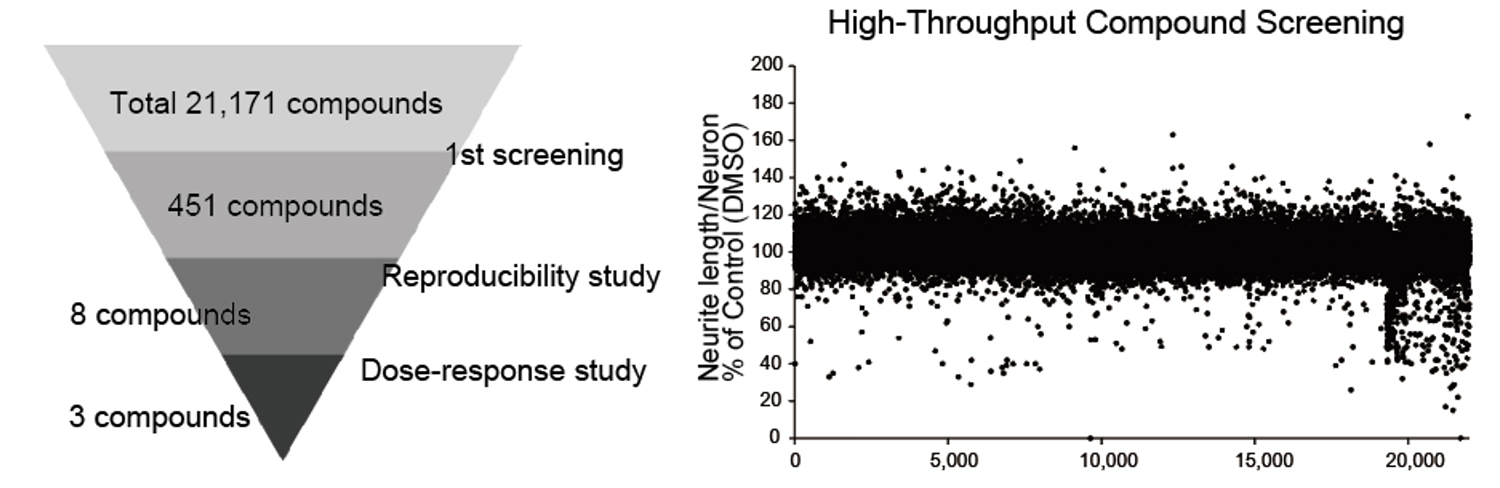
左:スクリーニングの流れ。21,171種類の化合物を対象に評価した。
右:コントロール群に対して各化合物を作用させた場合の神経突起の長さの変化率(%)を指標とした表現型スクリーニングの結果。
<関連情報>
- https://www.cira.kyoto-u.ac.jp/j/pressrelease/news/260427-150000.html
- https://www.cell.com/iscience/fulltext/S2589-0042(26)00904-1
ヒトiPSC由来ニューロンの表現型スクリーニングにより、チエノピリドン類が神経突起形成性小分子として同定された Phenotypic screening of human iPSC-derived neurons identifies thienopyridones as neuritogenic small molecules
Keiko Imamura ∙ Hiroshi Yukikate ∙ Takeshi Hioki ∙ … ∙ Yuko Arioka ∙ Norio Ozaki ∙ Haruhisa Inoue
iScience Published:March 30, 2026
DOI:https://doi.org/10.1016/j.isci.2026.115529
Highlights
- Phenotypic screening identifies neurite-promoting compounds in human iPSC-derived neurons
- Indazole hits identify TNIK as a kinase regulating neurite outgrowth
- Scaffold expansion reveals thienopyridone derivatives with neuritogenic activity
- Thienopyridones enhance neurite outgrowth in human neural organoids
Summary
Human induced pluripotent stem cell (iPSC)-derived neurons provide a platform for modeling brain disorders. Among disease-relevant cellular phenotypes, impaired neurite outgrowth has emerged as an indicator reflecting key aspects of neurological disease pathophysiology. We conducted a high-throughput phenotypic screening of over 21,000 small molecules to identify compounds that enhance neurite outgrowth in iPSC-derived neurons, and we identified three bioactive compounds sharing a common indazole scaffold. Notably, one of these compounds selectively targets TNIK, a kinase involved in neuronal development. Scaffold expansion led to the discovery of thienopyridone derivatives with potent neurite-promoting activity. Two thienopyridone compounds were further validated in a human neural organoid model, in which their neurite outgrowth-promoting effects were reproducibly confirmed. Transcriptomic profiling revealed activation of signaling pathways associated with neurotrophic stimulation. These findings identify thienopyridones as a scaffold for neuritogenic small molecules, suggesting their potential as a therapeutic strategy for brain disorders and for promoting neural regeneration.