2026-04-16 中国科学院(CAS)
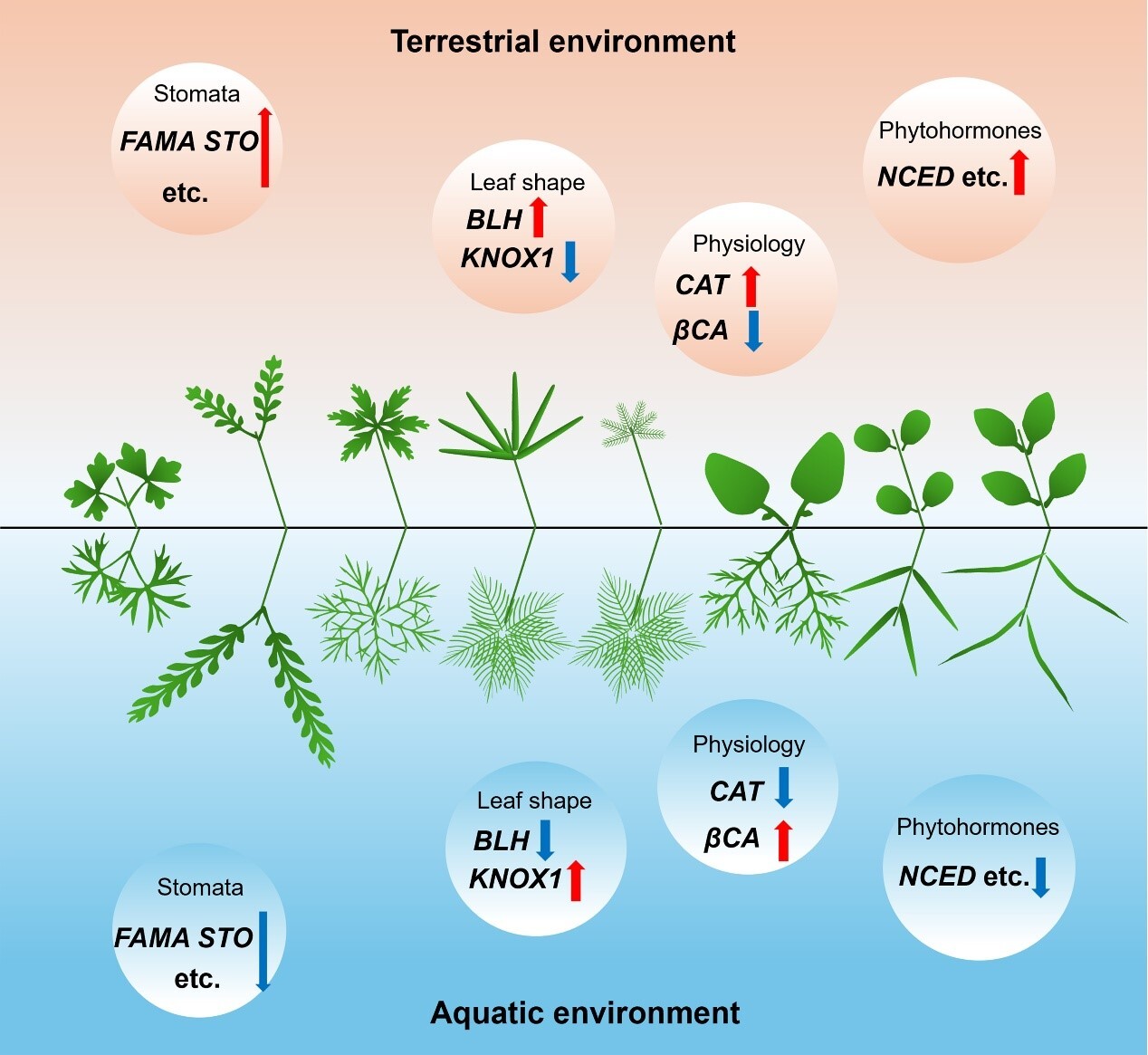
Conserved mechanisms of heterophylly regulation in aquatic plants (Image by IHB)
<関連情報>
- https://english.cas.cn/newsroom/research-news/202604/t20260428_1158198.shtml
- https://academic.oup.com/pcp/advance-article/doi/10.1093/pcp/pcag037/8537625?login=false
トランスクリプトーム解析により、8種の真正両生類に共通する異形葉性調節機構が明らかになった Transcriptomic analyses reveal common heterophylly regulations in eight amphibious eudicots
Gaojie Li,Tomoaki Sakamoto,Seisuke Kimura,Hongwei Hou
Plant and Cell Physiology Published:23 March 2026
DOI:https://doi.org/10.1093/pcp/pcag037
Abstract
Heterophylly, the ability of plants to produce various leaf forms in response to environments, is widely seen in nature. Aquatic plants emerged from various lineages of land plants, and amphibious species are those that can survive in both terrestrial and submerged conditions. In this study, we conducted phenotypical studies and transcriptomic analyses of eight amphibious eudicots. We quantified leaf shape changes under terrestrial and submerged conditions and found that dissection index is a proper indicator to quantify leaf complexity among heterophyllous species. We identified groups of differentially expressed genes related to heterophylly, mainly in terms of leaf shape, stomata development, and phytohormone biosynthesis. Different heterophyllous species have diverse regulations of leaf shape, and we verified the function of candidate class I KNOTTED1-LIKE HOMEOBOX genes using transgenic Arabidopsis lines. Stomatal densities are commonly decreased underwater, and genes related to their development are also downregulated. Abscisic acid may be a key factor regulating heterophylly, and CATALASE genes are upregulated under submergence. Our study has uncovered common and special characteristics among eight amphibious eudicots, providing resources to reveal mechanisms of heterophylly and convergent evolution.