
2026-05-07 京都大学
<関連情報>
- https://www.kyoto-u.ac.jp/ja/research-news/2026-05-07-2
- https://journals.plos.org/digitalhealth/article?id=10.1371/journal.pdig.0001382
スマートフォン過剰使用時代における内斜視発生率の上昇傾向:2014年~2019年の日本における全国規模の人口ベースコホート研究 Uptrend in esotropia incidence in the era of excessive smartphone use: A nationwide population-based cohort study in Japan, 2014–2019
Saori Wada ,Manabu Miyata ,Masahiro Miyake,Ai Kido,Takuro Kamei,Hiroaki Ueshima,Shinya Nakao,Akinari Yamamoto,Kenji Suda,Eri Nakano,Hiroshi Tamura,Akitaka Tsujikawa
PLOS Digital Health Published: April 22, 2026
DOI:https://doi.org/10.1371/journal.pdig.0001382
Abstract
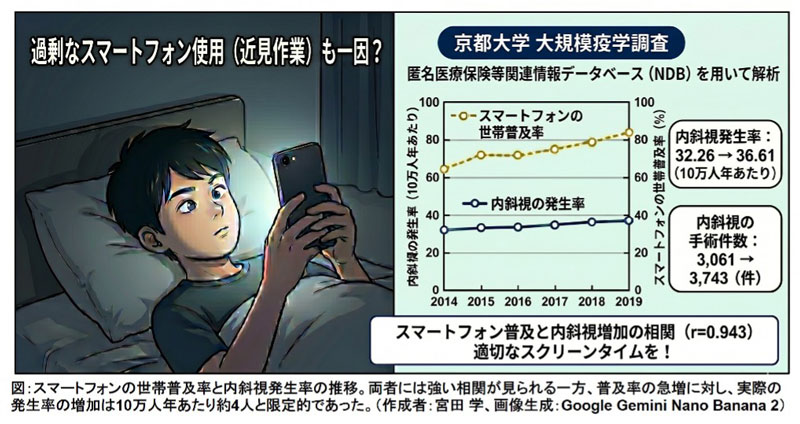
Acute acquired comitant esotropia (AACE) has recently garnered attention, as numerous case-series studies have reported its occurrence following excessive smartphone use. However, no large-scale epidemiological evidence of an increase in esotropia has been provided. This study aimed to investigate the change in the annual incidence of esotropia in Japan between 2014 and 2019—a period marked by a rapid increase in smartphone users. This nationwide population-based cohort study used the National Database of Health Insurance Claims and Specific Health Checkups of Japan, which covers almost the entire Japanese population. We counted the number of newly diagnosed esotropia cases and esotropia-related strabismus surgeries for each year from 2014 to 2019. Annual incidence rates were calculated by dividing these numbers by the corresponding year’s population. We also investigated the correlation between the annual incidence rate and smartphone household penetration, based on data from the Japanese Ministry of Internal Affairs and Communications. The annual incidence of esotropia gradually increased from 32.26 (95% confidence interval [CI], 31.95–32.57) to 36.61 (95% CI, 36.28–36.95) per 100,000 person-years between 2014 and 2019. The mean annual increase rate was 2.49 ± 1.62%. The number of esotropia-related strabismus surgeries also increased from 3,061 to 3,743 during the same period. The annual incidence of esotropia correlated significantly with smartphone household penetration (P = 0.005, r = 0.943). In conclusion, this ecological study provides the first population-based evidence of a significant uptrend in the annual incidence of esotropia and related strabismus surgeries in Japan between 2014 and 2019. The rapid increase in digital device use warrants caution and may be associated with this increase, suggesting a need for clinical guidelines on screen time.
Author summary
Acute acquired comitant esotropia causes the eyes to suddenly cross inward, resulting in double vision. Growing clinical concern links excessive smartphone use to this condition. However, large-scale nationwide epidemiological evidence tracking the actual number of patients with esotropia remained absent. Therefore, we investigated the change in the annual incidence of esotropia in Japan between 2014 and 2019—a period marked by a rapid increase in smartphone users—using the National Database of Health Insurance Claims and Specific Health Checkups of Japan, covering nearly the entire population. We found that the annual incidence of esotropia gradually increased from 32.26 to 36.61 per 100,000 person-years between 2014 and 2019. Furthermore, the number of esotropia-related strabismus surgeries increased from 3,061 to 3,743 during the same period. The annual incidence of esotropia correlated significantly with smartphone household penetration. These results suggest that excessive near-work on digital devices exhausts the eyes’ ability to maintain proper alignment, particularly in individuals with an underlying tendency for their eyes to cross. The rapid increase in digital device use warrants caution and may be associated with this increase, suggesting a need for clinical guidelines on screen time.

