2026-05-08 中国科学院(CAS)
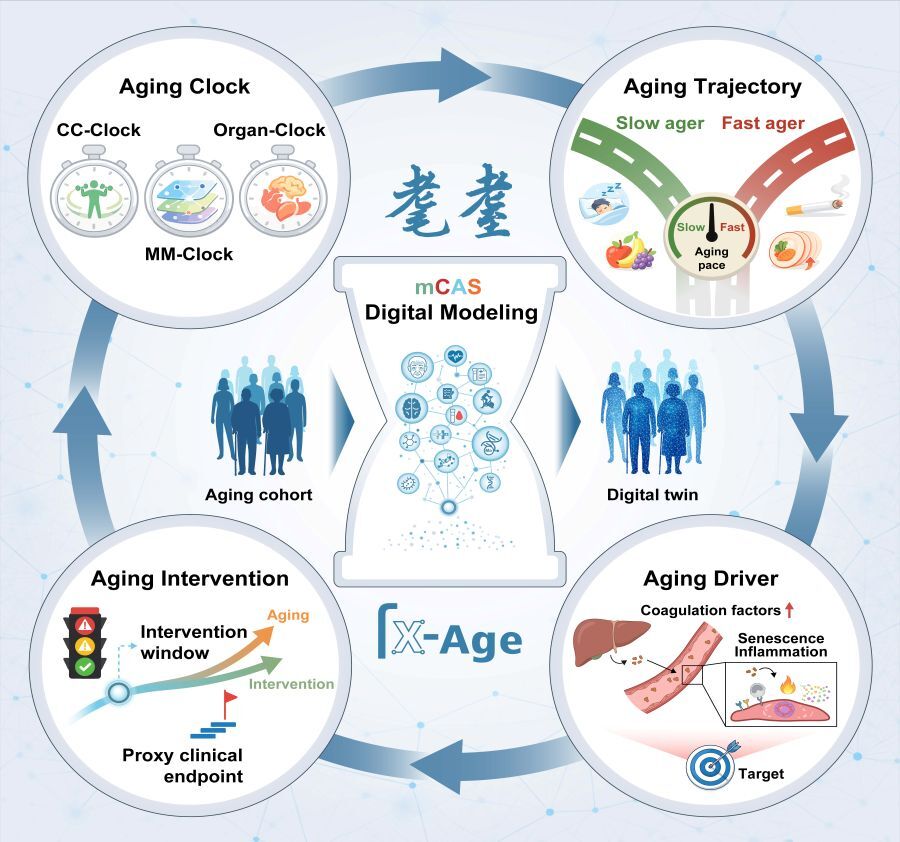
X-Age framework for multidimensional aging assessment and digital modeling. (Image by ABC)
<関連情報>
- https://english.cas.cn/newsroom/research-news/202605/t20260509_1158637.shtml
- https://www.cell.com/cell/abstract/S0092-8674(26)00460-5
人間の老化に関するマルチモーダル時計 Multimodal clocks of human aging
Jiaming Li ∙ Beier Jiang ∙ Wei Zhang ∙ … ∙ Guoguang Zhao ∙ Weiqi Zhang ∙ Guang-Hui Liu
Cell Published:May 8, 2026
DOI:https://doi.org/10.1016/j.cell.2026.04.025
Highlights
- Multimodal clocks define a quantitative framework for human aging
- Aging biomarkers and trajectories are highly conserved across multiple centers
- Plasma proteomic signals provide a compact, sensitive readout of systemic aging
- Coagulation-factor accumulation is identified as both a biomarker and driver of aging
Summary
Human aging is characterized by complex structural and functional decline, but quantifying its heterogeneity and assessing biological age remain challenges. We present the mCAS (multicentric Chinese aging standardized cohort) developed from 2,019 Chinese individuals aged 18–91 years. Integrating high-dimensional clinical, physiological, and molecular-level data, we constructed a three-tiered aging framework: the core capacity clock (CC-clock) to quantify clinical physiological decline, the multimodal clock (MM-clock) with extensive parameter coverage and enhanced predictive precision, and organ-associated aging clocks. Cross-layer analysis demonstrates that plasma protein clocks not only capture chronological age but also serve as efficient proxies for systemic physiological capacity. Leveraging this framework for discovery, we identified the age-dependent accumulation of coagulation factors as a driver of multi-organ senescence and systemic inflammatory activation. This study provides a foundational framework that bridges molecular signatures with functional decline, identifies new biomarkers for aging assessment, and reveals a novel translational driver of aging.