2026-05-15 中国科学院(CAS)
<関連情報>
- https://english.cas.cn/newsroom/cas-in-media/202605/t20260515_1159462.shtml
- https://www.nature.com/articles/s41586-026-10489-5
脂質-ヌクレオチド多層膜液滴の分裂における非対称分裂 Asymmetric splitting in dividing lipid-nucleotide multilamellar droplets
He Meng,Liyan Jia,Dong Qiu,Yiyang Lin,Shu Wang,Stephen Mann & Yan Qiao
Nature Published:13 May 2026
DOI:https://doi.org/10.1038/s41586-026-10489-5
Abstract
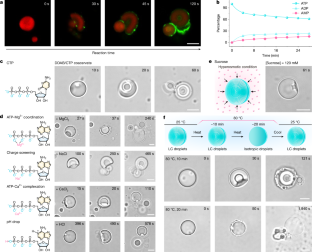
Liquid crystalline droplets with molecularly crowded interiors capable of selective biomolecular sequestration and interfacial wetting have been recently developed for the construction of artificial cells (protocells) and chain-like protocell networks1,2,3. The controlled division of these synthetic protocells4,5,6,7,8,9,10,11,12,13,14,15,16, however, remains a challenge. Symmetric fission of vesicles and droplets has been shown17,18,19,20,21,22,23,24,25,26 using thermal gradients, dissipative self-assembly, wetting energies and chemical reactions27,28,29,30,31, but asymmetric division is rare. For example, osmotic pressure has been used to induce the asymmetric division of lipid vesicles containing a polyethylene glycol–dextran aqueous two-phase system32 as well as giant unilamellar vesicles prepared with lipid-phase-separated bilayers33. Here we show that structured liquid droplets exhibit asymmetric division in the absence of reconstituted protein machinery. In the presence of alkaline phosphatase or multivalent metal cations, individual multilamellar droplets split to produce two morphologically distinct progeny (droplet and vesicle). We show that heteromorphic division occurs by circumferential growth of a single surface caveola along a latent core–shell domain boundary because of induced changes in lipid headgroup–nucleotide counterion interactions and demonstrate that functional biomolecules are transferred between the different protocell generations. Taken together, our results provide a step towards the bottom-up assembly of proliferating artificial cells.