2026-05-19 琉球大学
<関連情報>
腸内細菌叢は脳マラリア疾患モデルにおける防御と重症度の双⽅向に影響を与える Gut microbiota bidirectionally influences protection and severity in cerebral malaria in mice
Tomoyo Taniguchi,Eiji Miyauchi,Reika Kawabata-Iwakawa,Masahiko Nishiyama,Rika Umemiya-Shirafuji,Hiromu Toma,Nobuo Sasaki,Hajime Hisaeda,Haruyoshi Tomita,Hiroshi Ohno,Hidehiro Kishimoto & Hiroshi Suzuki
Tropical Medicine and Health Published:16 April 2026
DOI:https://doi.org/10.1186/s41182-026-00947-1
Abstract
Background
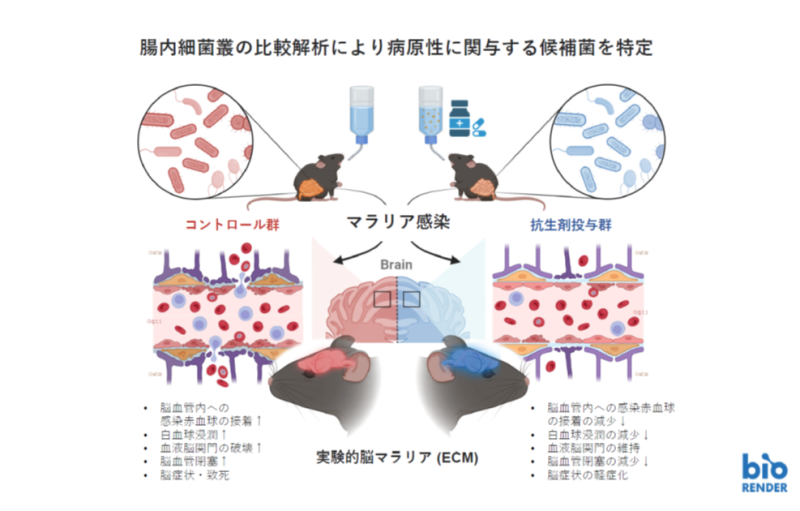
Malaria caused by Plasmodium parasites leads to severe complications, such as cerebral malaria; however, the influence of the gut microbiota on the pathogenesis of cerebral malaria remains unclear. Here, the effects of antibiotic-induced microbiota alteration on experimental cerebral malaria (ECM) were examined.
Methods
Male C57BL/6N mice that were administered drinking water containing a four-antibiotic cocktail, ampicillin, neomycin, metronidazole and vancomycin, from 2 weeks before P. berghei ANKA (PbA) infection were used for the experiments. Disease progression, blood–brain barrier (BBB) integrity, immune responses, and gut microbiota composition were evaluated.
Results
Approximately 80% of mice with modified gut microbiota avoided ECM and showed reduced BBB disruption and lymphocyte infiltration into the brain. 16S rRNA gene sequencing revealed specific bacterial species that contributed to either the protection or pathogenesis of ECM. The mono-colonization of germ-free mice revealed that distinct bacterial species could attenuate or exacerbate ECM symptoms, independent of antibiotic effects.
Conclusions
The findings highlight that distinct gut microbial populations can modulate host susceptibility or resistance to ECM, underscoring the important influence of the intestinal microbiota on infectious disease outcomes. This work broadens the understanding of host‒microbe interactions and may inform new strategies for managing cerebral malaria through microbiota modulation.