2026-05-20 名古屋大学
<関連情報>
- https://www.nagoya-u.ac.jp/researchinfo/result/2026/05/post-997.html
- https://www.cell.com/device/fulltext/S2666-9986(26)00105-5
離散的なポリケトンにより、選択的なエクソソームプロファイリングのための抗体クリックコンジュゲーションが可能になる Discrete polyketones enable antibody click conjugation for selective exosome profiling
Kunanon Chattrairat ∙ Akira Yokoi ∙ Yumehiro Manabe ∙ … ∙ Hiroaki Kajiyama ∙ Yasuhide Inokuma ∙ Takao Yasui
Device Published:May 19, 2026
DOI:https://doi.org/10.1016/j.device.2026.101153
The bigger picture
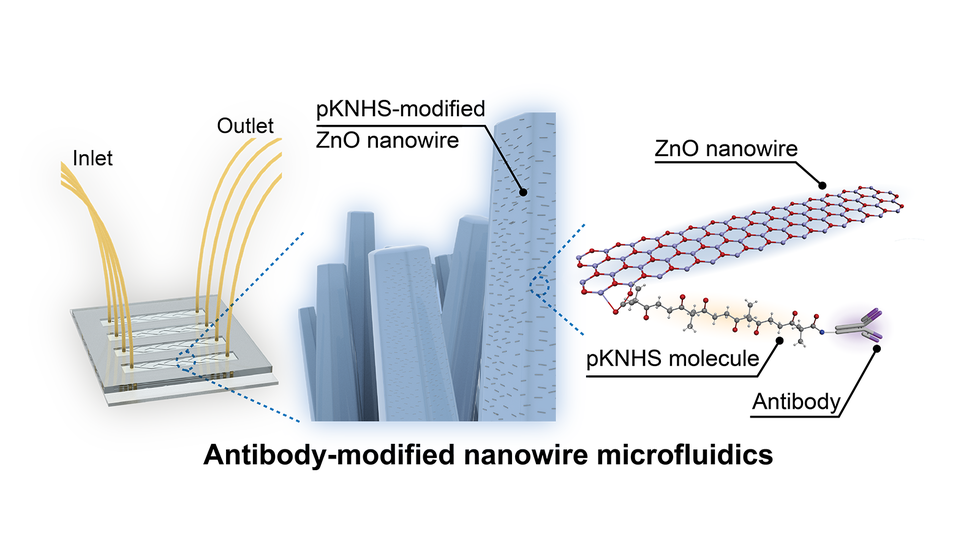
Extracellular vesicles (EVs) have great potential as non-invasive biomarkers for early disease detection, offering a liquid biopsy alternative to conventional tissue sampling methods. However, capturing targeted EVs from complex biological fluids like blood is still challenging due to interfering substances. Here, we introduce a microfluidic platform using nanowires conjugated to antibodies via discrete polymers. This approach increases capture efficiency, specificity, and yield while reducing background noise. Use of this platform successfully isolated and identified targeted EVs and their miRNAs from patient serum with high-grade serous ovarian carcinoma, thereby demonstrating the potential to improve the accuracy of early disease detection. This platform and its advanced surface engineering technology have strong potential to develop accessible, high-performance diagnostic tools, paving the way for routine blood tests that reliably detect diseases at their earliest, most treatable stages.
Highlights
- Nanowire microfluidics capture targeted EVs directly from complex biological fluids
- Discrete polymers enable stable, single-step antibody immobilization
- The platform identifies distinct miRNA signatures in ovarian cancer patient serum
- Modular surface chemistry enhances non-invasive liquid biopsy diagnostics
Summary
Targeted molecular capture from complex biological fluids remains a critical challenge in extracellular vesicle (EV) analysis. Here we develop a nanowire-based microfluidic platform functionalized via a single-step click conjugation using N-hydroxysuccinimide ester-functionalized polyketones (pKNHSs) with discrete chain lengths. Tetrameric pKNHSs enabled efficient and stable antibody immobilization on ZnO nanowires while minimizing non-specific adsorption. This chemically defined interface facilitated the selective capture of EVs from both cultured cells and serum, preserving membrane proteins and encapsulated miRNAs. Using antibody-modified nanowires, we identified distinct miRNA signatures associated with specific membrane markers in serum samples from patients with high-grade serous ovarian carcinoma. These results highlight the ability of discrete, chain-engineered polyketones to enable robust and tunable bioconjugation chemistry. The discrete-length polymer design also offers a generalizable strategy for precision surface engineering. Our approach offers a modular strategy for EV enrichment and molecular profiling with potential applications in liquid biopsy and precision diagnostics.