2026-05-21 コペンハーゲン大学
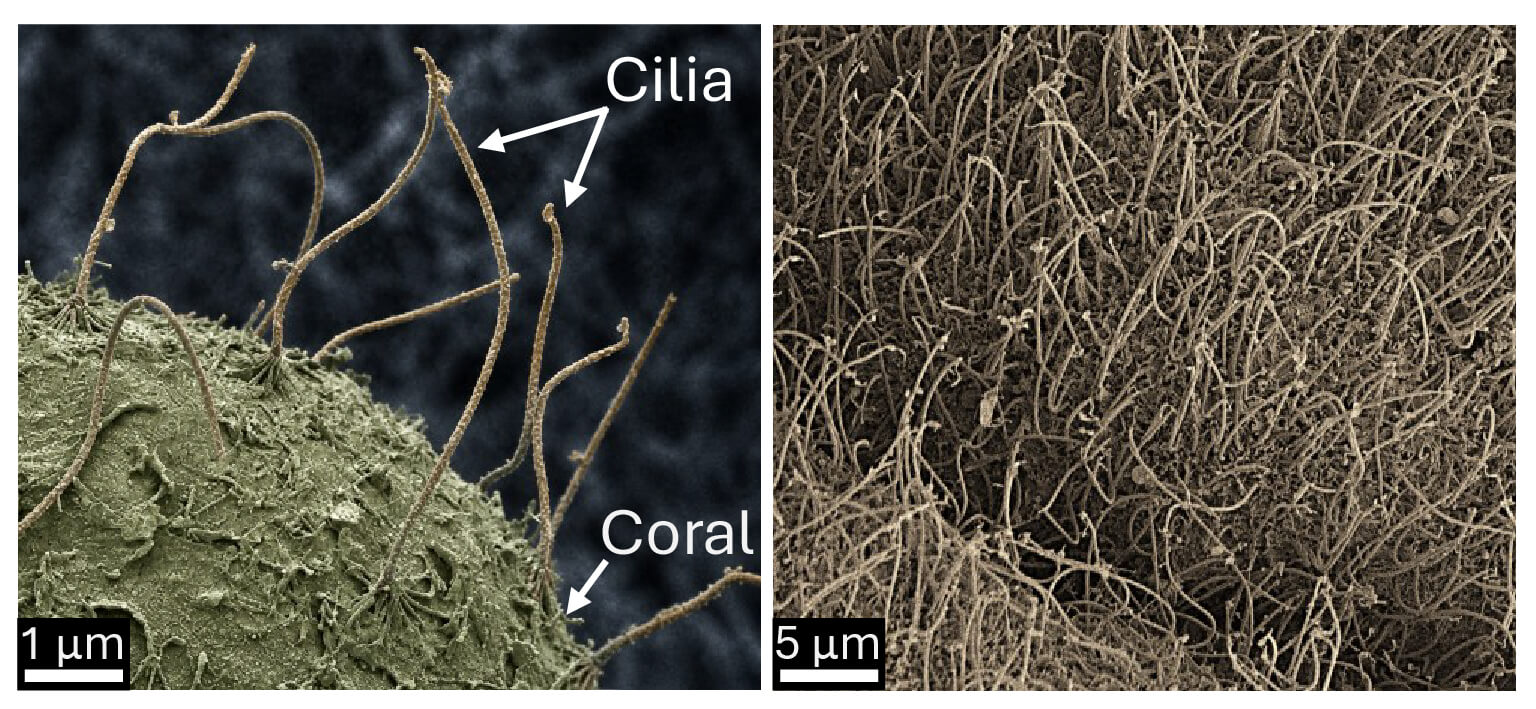
Electron microscopy images of cilia on the surface of corals. Note that the cilia are approximately 10–15 micrometres long and around 500 times thinner than a human hair. (Photo: Cesar Pacherres, University of Copenhagen)
<関連情報>
- https://news.ku.dk/all_news/2026/05/warming-oceans-can-disrupt-coral-oxygen-supply-and-trigger-coral-death/
- https://www.science.org/doi/10.1126/sciadv.aeg0950
急激な温度変化が繊毛運動に及ぼす影響により、サンゴの脱酸素化が進む Acute temperature effects on cilia beating increase coral deoxygenation
Cesar O. Pacherres, Max S. Dhillon, Mads Bilbo, Mikkel Hansen, […] , and Michael Kühl
Science Advances Published:20 May 2026
DOI:https://doi.org/10.1126/sciadv.aeg0950
Abstract
Cilia-induced vortical flows are critical for regulating oxygen (O2) and metabolite exchange across coral-water interfaces. While this active ventilation affects the coral tissue microenvironment, its role in thermal stress remains poorly understood. Using high-speed imaging of cilia beating, particle image velocimetry with O2-sensitive nanoparticles, and a mechanistic transport model, we quantified how ciliary dynamics in the reef-building coral Porites lutea respond to acute warming in darkness. Moderate warming (~35°C) enhanced ciliary activity and advective transport yet paradoxically thickened the concentration boundary layer with O2-depleted water, exposing tissues to transient hypoxia. At higher temperatures, ventilation failed to meet rising metabolic demands and anoxic regions expanded rapidly. Above ~37°C, ciliary coordination collapsed and vortical flows dissipated, shifting transport to a diffusion-limited regime accelerating coral mortality. These results identify ciliary beating as a key regulator of thermal tolerance and early indicator of critical physiological tipping points for reef-building corals in a warming, deoxygenating ocean.