2026-05-20 イェール大学
<関連情報>
- https://news.yale.edu/2026/05/20/warmer-temps-heavier-owl-monkeys-climate-linked-weight-gain-primates
- https://royalsocietypublishing.org/rspb/article/293/2071/20253004/481778/Rapid-weight-increases-in-a-primate-population
霊長類集団における急速な体重増加:気候変動に対する可塑的反応の証拠か? Rapid weight increases in a primate population: evidence of a plastic response to climate change?
Jonathan Alexander Pertile;Eric J. Sargis;Eduardo Fernandez-Duque
Proceedings of the Royal Society B Published:20 May 2026
DOI:https://doi.org/10.1098/rspb.2025.3004
Abstract
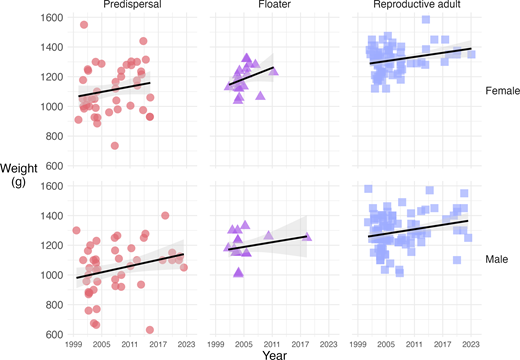
Climate-change-associated decreases in body weight are often predicted because of changing thermoregulatory costs in warmer environments, but evidence for and mechanisms underlying such changes remain elusive. We leverage over two decades of research and 287 weight measurements of Azara’s Owl Monkeys (Aotus azarae azarae) to investigate the relationships among temperature, weight and various confounders and report, for the first time in a non-human primate population, rapid mean weight increases. Owl monkey individuals are 50 g heavier in 2023 than in 1999, coinciding with a >1℃ temperature rise. Although heavier individuals may be more likely to reproduce, the potential response to selection is too small to explain this increase. Furthermore, elevated temperatures during post-natal development, not adulthood, are associated with higher weights, suggesting that warmer temperatures during growth may decrease thermoregulatory costs and promote weight acquisition. These results align with the mean weight increase representing a plastic response to a changing environment. These findings highlight the complexity of primate body weight as a plastic phenotype and the need for further research on climate and ecogeographical rules.