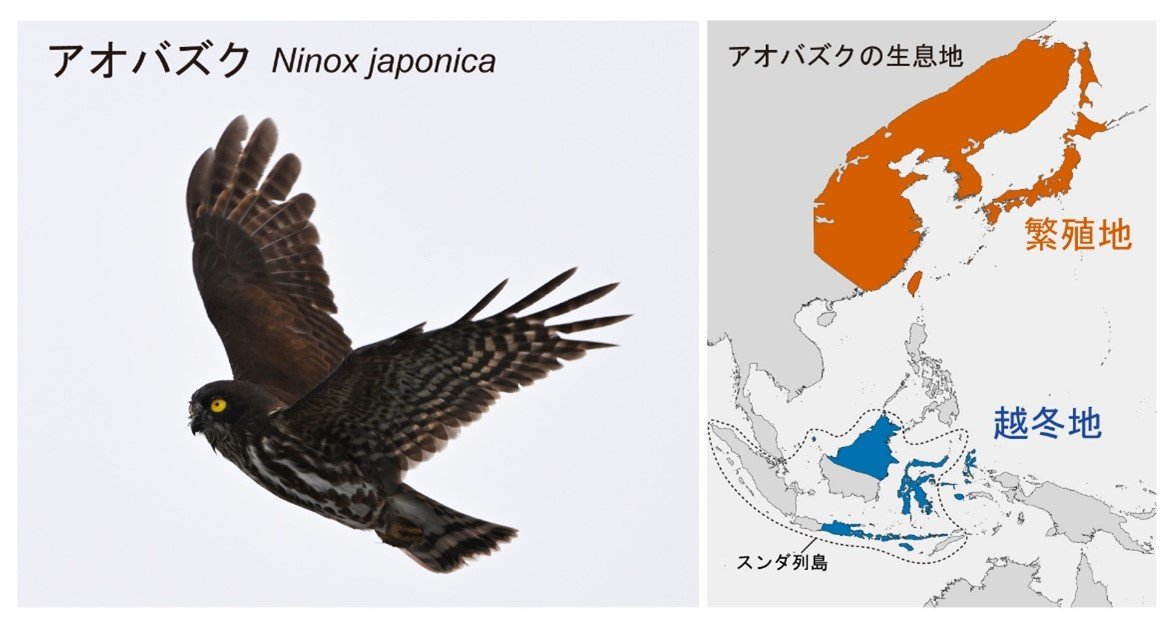
図1. アオバズクとその生息地:東アジアで繁殖し、東南アジアで冬を過ごすことが知られている。左写真は青森県沖のフェリー航路上で観察された渡り中の移動個体(中村咲子氏提供)。
2026-06-11 東北大学
- https://www.tohoku.ac.jp/japanese/2026/06/press20260611-01-owl.html
- https://link.springer.com/article/10.1186/s40317-026-00469-x
事例報告:年間を通じたGPS追跡によって明らかになった、キタアオ Case report: long-distance overwater migration of the Northern Boobook, Ninox japonica, revealed by year-round GPS tracking
Yawara Takeda,Masanori Tatani,Kozue Shiomi & Jun Hosoya
Animal Biotechnology Published:07 June 2026
DOI:https://doi.org/10.1186/s40317-026-00469-x Unedited version
Abstract
Background
Relative to extensive research on soaring raptors, the propensity for overwater movement of owls is poorly known. To provide insights into the migratory routes of an owl species, Northern Boobooks Ninox japonica, breeding in East Asia, we attached GPS loggers to male Northern Boobooks in the Tohoku region of Japan.
Results
A GPS logger successfully recorded the full annual cycle of one male, showing an example of a clockwise loop migration between Japan and Southeast Asia. The migration route via Luzon, Philippines, was consistent with previous band-recovery data. In both autumn and spring, the tracked owl undertook ocean crossings exceeding 1400 km. In wintering ground, the owl used a four-year-old secondary forest surrounded by oil palm plantations in Kalimantan, Indonesia.
Conclusions
This tracking record provides the first detailed description of the migration route of owls along the East Asian flyway and an initial insight into the migration and wintering ecology of the Northern Boobook. Our GPS tracking data, while not a statistically sufficient sample size, suggest that this species performs long-distance overwater migration.