2026-08-24 北海道大学
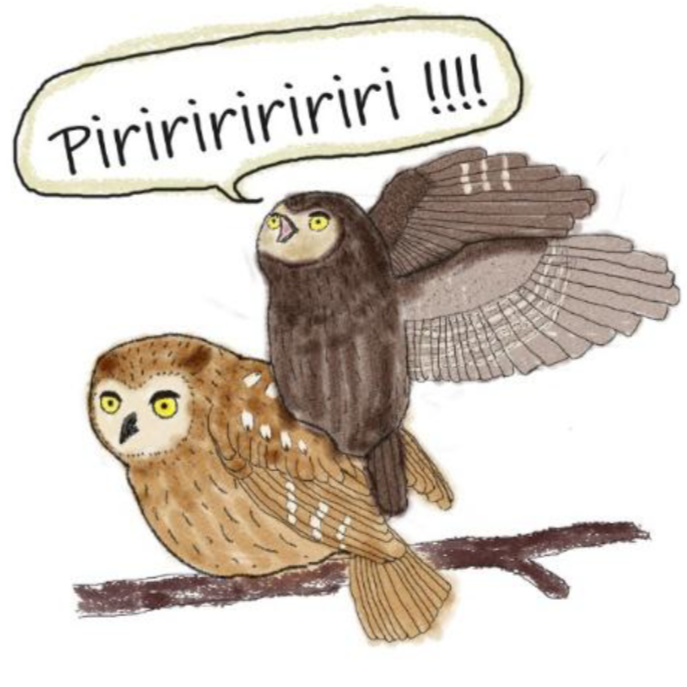
交尾声を出すリュウキュウコノハズクのイメージ図。
交尾をしている間に、「ぴりりりり」という目立つ声を発する。
<関連情報>
- https://www.hokudai.ac.jp/news/2026/08/post-2423.html
- https://www.sciencedirect.com/science/article/abs/pii/S0003347226002198
リュウキュウコノハズクは、パートナーではない個体が発する交尾の鳴き声に対して強い鳴き声で反応する Ryukyu scops owl exhibits strong vocal responses to copulation calls produced by nonpartner individuals
Naoki Kanasugi, Akira Sawada, Haruka Nakamura, Ryuta Sasaki, Junpei Hosoe, Masaoki Takagi
Animal Behaviour Available online: 22 August 2026
DOI:https://doi.org/10.1016/j.anbehav.2026.123682
Highlights
- Ryukyu scops owls gave copulation calls exclusively during the prelaying period.
- Ryukyu scops owls were capable of identifying copulation calls.
- Strong vocal responses to copulation calls of nonpartner individuals were observed.
- Strong vocal responses to copulation calls were observed in both sexes.
Vocalizations made during copulation (copulation calls) are a widespread behaviour among mammals and birds. The function of copulation calls has been little studied, although it has been suggested that they serve as complex communication between partner individuals and even between nonpartner individuals. Functions such as territorial signalling and intersexual attraction have been proposed for copulation calls. We examined the function of copulation calls by investigating how wild Ryukyu scops owl, Otus elegans, respond vocally to recordings of copulation calls given by nonpartner individuals. This is the first avian study examining sexual differences in responses to copulation calls. Playback experiments indicated that both male and female individuals of established pairs responded more strongly to playback of sounds including copulation calls than to playback of sounds without copulation calls. The rate of change in the onset of vocal response was significantly greater for males than for females, whereas no significant sex differences were found in the number of responses and the duration of responses. These results suggest that copulation calls may function in territorial signals, eliciting strong vocal responses from both nonpartner males and females. Ryukyu scops owl give copulation calls (at a rate of 0.198 times/h) only during the prelaying period from February to April. During experiments using playback of duet calls, territorial breeding individuals responded at an increased frequency of 1.45 copulation calls/h. This increased rate of response also suggests that copulation calls may serve as territorial signals.