2026-07-02 京都大学
本研究の概要
<関連情報>
- https://www.kyoto-u.ac.jp/ja/research-news/2026-07-02-3
- https://onlinelibrary.wiley.com/doi/10.1002/ece3.73882
色彩の多様性を解き明かす:市民科学によって明らかになったオオムカデ属2種における生態地理学的パターン Untangling Colour Diversity: Ecogeographic Patterns in Two Scolopendra Species Revealed by Citizen Science
Ryosuke Uno, Shouta Iyoda
Ecology and Evolution Published: 23 June 2026
DOI:https://doi.org/10.1002/ece3.73882
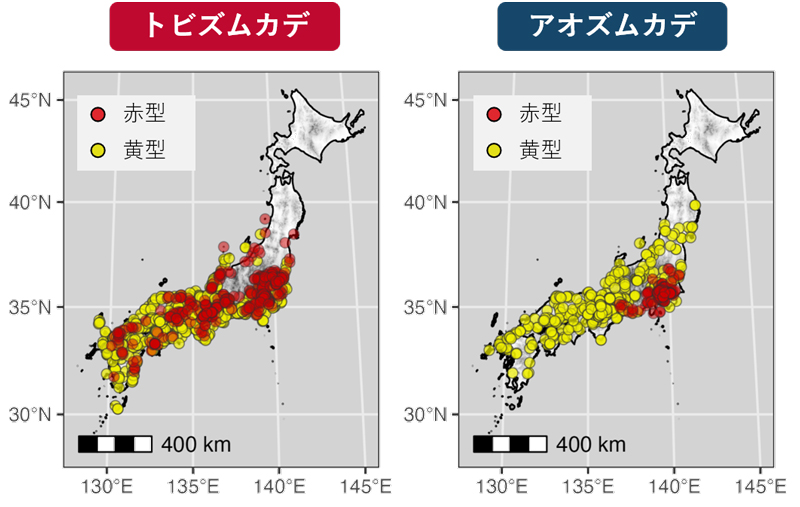
ABSTRACT
In closely related sympatric species with similar ecologies, the adaptive significance of body colour is generally expected to be similar. Here, we explore the evolutionary drivers and maintenance mechanisms behind identical colour variants in two ecologically comparable centipede species. Location: Japan [excluding the Nansei Islands]. Taxon: Centipedes. We collected georeferenced photographic records of Scolopendra mutilans and S. japonica through citizen science, assessed phenotypes (red-legged or yellow-legged) and mapped their distributions. We analysed predators and prey from photographs and occurrence records using spatial point pattern models and realised climatic niche analysis. The two species showed broadly overlapping ranges, predators, prey and climatic niches. In contrast, co-occurrence patterns of phenotypic variation differed markedly: in S. mutilans, the two colour variants were sympatric nationwide, whereas in S. japonica they co-occurred in restricted Pacific coastal areas. Within S. mutilans, the variants differed in associated predator species, and their realised climatic niches showed significant but small differences. Within S. japonica, the realised niche of the red-legged variant was fully nested within that of the yellow, with neither prey nor predator differences detected. Colour diversity of S. mutilans and S. japonica is probably maintained by distinct mechanisms. In S. mutilans, the red- and yellow-legged variants show slightly divergent realised climatic niches; however, how these climatic factors generate leg-colour variation remains unclear. Conversely, photographic data provide strong evidence for differential selection by distinct predator groups, suggesting that this variation is maintained through locally divergent anti-predator adaptations. In S. japonica, the restricted distribution and nested niche of the red-legged variant, possibly from a recent introduction, suggest it is not maintained by the same selective pressure observed in S. mutilans. More broadly, similar phenotypic variation in closely related species may be shaped by different evolutionary processes, including ecological selection and stochastic or historical contingency.