2026-05-12 島根大学
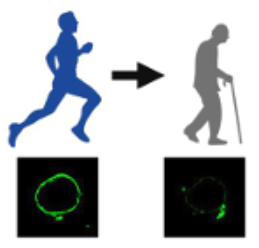
加齢による核膜LINC複合体 の発現低下(大脳皮質神経細胞)
<関連情報>
- https://www.shimane-u.ac.jp/_files/00426220/20260522pr.pdf
- https://link.springer.com/article/10.1038/s44319-026-00786-5
加齢に伴う核膜LINC複合体の減少は、軸索起始部機能不全を介して神経細胞の老化を促進する Age-related decline in nuclear envelope LINC complex drives neuronal aging via axon initial segment dysfunction
Koichi Hasegawa,Noriyuki Hama,Mina Amemiya,Chao Zeng,Yasuyuki Ito,Sadafumi Suzuki,Keiichiro Nakamura,Junpei Kondo,Chiharu Takeda,Yuji Kurihara,Kazuho Ikeda,Yuki Fujita,Yasushi Okada,Atsushi Toyoda,Michiaki Hamada & Ken-ichiro Kuwako
EMBO Reports Published:22 May 2026
DOI:https://doi.org/10.1038/s44319-026-00786-5
Abstract
Brain aging is an intricate process that inevitably leads to functional deterioration. However, its molecular drivers remain unclear. Here, we show that the age-related decline in LINC complex expression on the neuronal nuclear envelope impairs axon initial segment (AIS)-mediated excitability and triggers brain aging. With aging, the expression of LINC complex components, including Sun1, decreases in various brain regions, accompanied by a reduction in AIS length. Preserving Sun1 expression rescues nuclear structural abnormalities in aged neurons, shifting chromatin dynamics and global gene expression toward those of young neurons. Particularly, it restores the expression of AIS-related molecules, including voltage-gated sodium or potassium channels essential for action potential generation. Inhibiting the LINC complex in young mice impairs AIS integrity, leading to reduced neuronal excitability and brain dysfunction. Furthermore, Sun1 administration to aged neurons prevents age-related AIS shortening, excitability impairment, and brain function changes. Thus, we uncover the mechanism of normal brain aging involving AIS dysfunction, identifying the LINC complex component Sun1 as essential for preserving brain function.