2026-05-29 名古屋市立大学
<関連情報>
- https://www.nagoya-cu.ac.jp/press-news/202605291000/
- https://www.nature.com/articles/s41467-026-73505-2
光および化学物質によって誘発される繊毛シグナル伝達が、ヒト終脳オルガノイドの背腹領域分化を制御する Light- and chemical-induced ciliary signaling governs dorsal/ventral regionalization of human telencephalic organoids
Issei S. Shimada,Akari Goto,Yutaka Hashimoto,Hajime Inoue,Takuto Sugawara,Tomohiro Doura,Tsubasa Fujita,Toshiaki Iwata,Riko Shimmoto,Hiroshi Takase,Masayuki Itoh,Shigeki Kiyonaka & Yoichi Kato
Nature Communications Published:22 May 2026
DOI:https://doi.org/10.1038/s41467-026-73505-2 Unedited version
Abstract
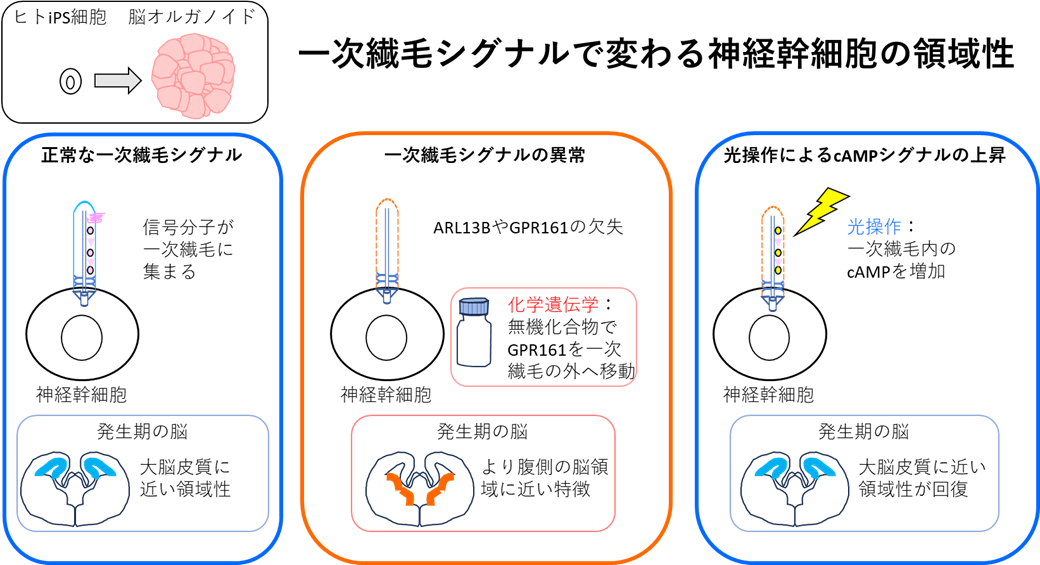
Neural stem/progenitor cells (NPCs) have primary cilia, which are critical organelles for Sonic hedgehog signaling. However, little is known about the components of primary cilia in NPCs and whether manipulating signaling in the cilia is sufficient to alter dorsal/ventral regional identity. Using a human telencephalic organoid model, we perform comprehensive proteomic profiling of NPC cilia and find enrichment in GTPase signaling. Deletion of the ciliary GTPase ARL13B reduces ciliary localization of GPR161, an orphan G protein-coupled receptor 161 that negatively regulates Sonic hedgehog, resulting in ventralization of NPCs. GPR161 deletion also induces ventralization. To investigate whether manipulation of ciliary signaling is sufficient to restore dorsal identity in this context, we optogenetically elevate ciliary cAMP, rescuing dorsal fate in GPR161 KO organoids. Furthermore, chemogenetic induction of GPR161 removal from cilia is sufficient to increase ventral NPCs. These data indicate that ciliary signaling functions as a critical switch regulating dorsal/ventral fate decisions.