2026-05-14 中国科学院(CAS)
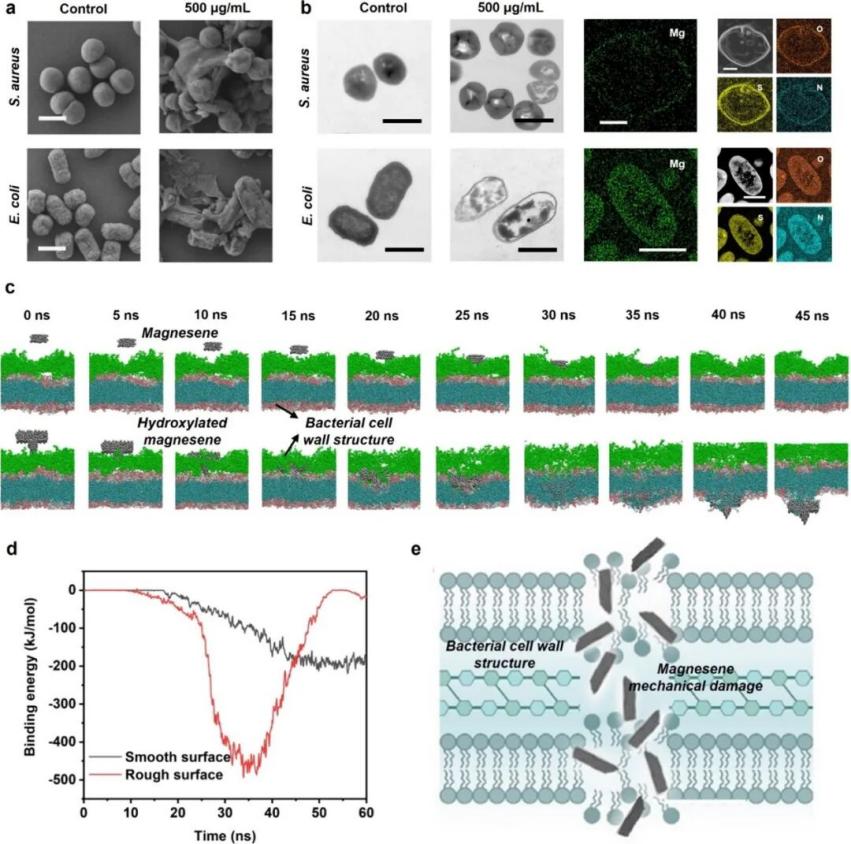
Structural, simulation, and membrane damage analysis reveal magnesene’s preferential interfacial interaction and mechanical disruption mechanism on bacterial membranes. (Image by SICCAS)
<関連情報>
- https://english.cas.cn/newsroom/research-news/202605/t20260529_1160101.shtml
- https://pubs.acs.org/doi/10.1021/jacs.5c20581
Microenvironment Magnesium Overload Disrupts Bacterial Membrane Functions for the Central Nervous System Infection Treatment
Yihan ChenYuanqing Ding,Wencheng Wu,Yanling You,Zhixin Chen,Ya-Xuan Zhu,Ruoxi Zhao,Zhimin Zhang,Zezhen Zhang,Yiming Tao,Rong Xie,Han Lin,and Jianlin Shi
Journal of the American Chemical Society Published: May 13, 2026
DOI:https://doi.org/10.1021/jacs.5c20581
Abstract
Bacterial infections of the central nervous system (CNS) remain life-threatening disorders with high mortality, largely due to limited drug permeability across the blood–brain barrier and dose-dependent toxicities of conventional antimicrobials. Here, we report a two-dimensional magnesene nanosheet generated by low-temperature ultrasound exfoliation of magnesium crystals via selective activation of dislocations and slip systems. The resulting material releases abundant Mg2+ ions at the bacterial interface, inducing localized magnesium overload and mechanical disruption of membrane integrity. This dual physicochemical stress impairs membrane-associated transport in Staphylococcus aureus and Escherichia coli, ultimately triggering rapid bactericidal effects. Magnesene exhibits potent and broad-spectrum antimicrobial activity in vitro, and analysis of clinical cerebrospinal fluid samples from CNS-infected patients further confirms its translational potential in reducing microbial burden. In rat CNS infection models, magnesene markedly suppresses bacterial proliferation and attenuates neuroinflammation. As a novel inorganic nanomedicine, magnesene offers a promising strategy for combating refractory CNS infections and may broaden therapeutic options against diverse microbial pathogens.