2026-05-29 中国科学院(CAS)
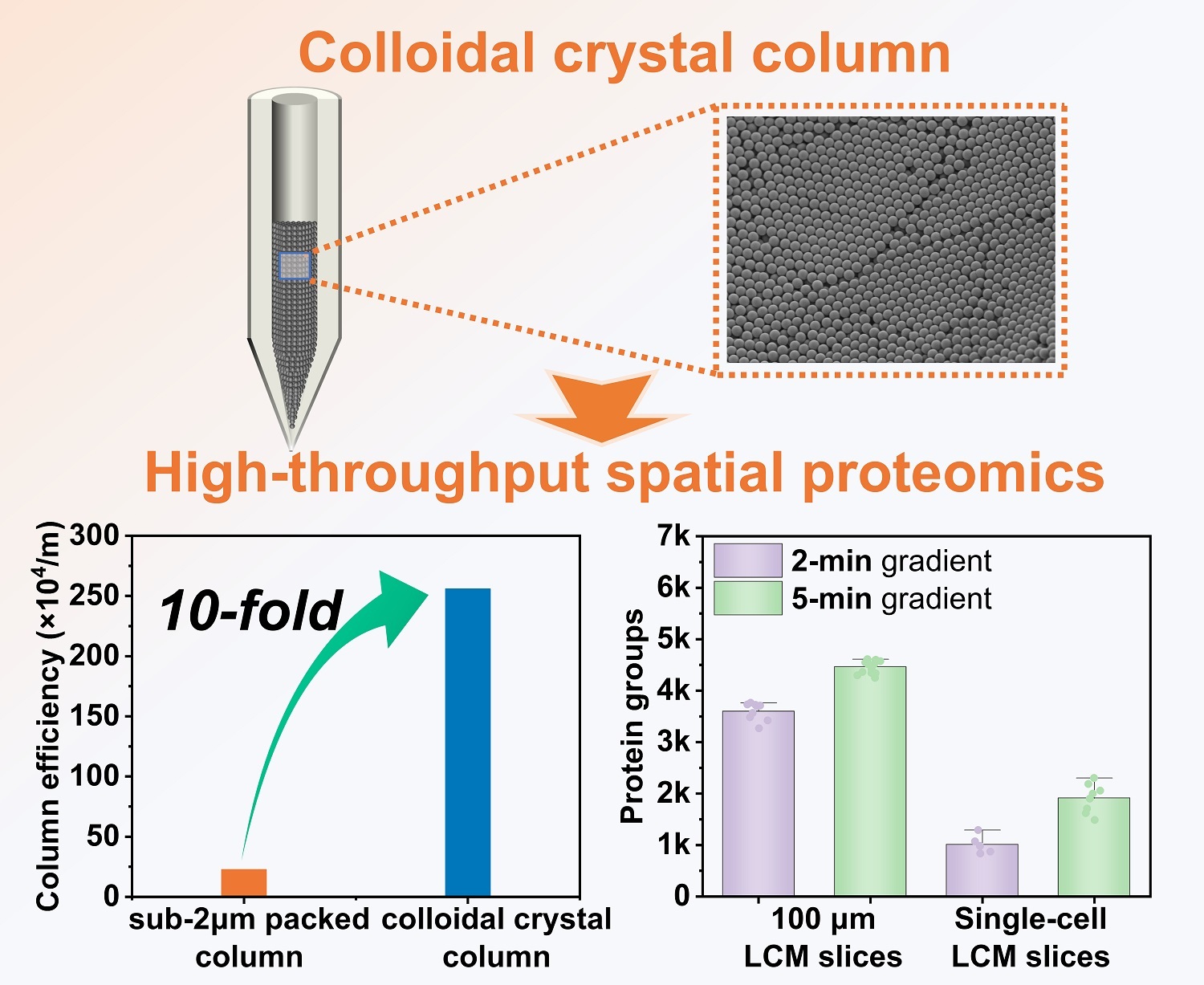
A colloidal crystal chromatographic column assembled from 800 nm monodisperse C18 silica spheres exhibits a tenfold higher column efficiency than conventional sub-2 μm columns, enabling high-throughput spatial proteomics under ultra-short gradients with spatial resolution down to the single-cell level. (Image by SUN Haofei and LIANG Yu)
<関連情報>
- https://english.cas.cn/newsroom/research-news/202605/t20260529_1160070.shtml
- https://onlinelibrary.wiley.com/doi/10.1002/anie.8045649
秩序だったコロイド結晶カラムによって実現された、高スループットな単一細胞分解能空間プロテオミクス High-Throughput Single-Cell-Resolved Spatial Proteomics Enabled by an Ordered Colloidal Crystal Column
Haofei Sun, Chao Wang, Kun Guo, Shan Li, Jianhong Wu, Liming Wang, Baofeng Zhao, Zhen Liang, Yu Liang, Lihua Zhang, Yukui Zhang
Angewandte Chemie International Edition Published: 27 April 2026
DOI:https://doi.org/10.1002/anie.8045649
ABSTRACT
Spatial proteomics is essential to elucidate biological function and pathogenesis, for which nanoLC–MS coupled with tissue microdissection is a powerful tool. However, the throughput is limited by the time-consuming nanoLC–MS analysis of numerous microdissected slices. Herein, to boost the throughput of spatial proteomics, an ordered colloidal crystal column was developed for fast nanoLC–MS analysis of microdissected slices with low-input amounts, down to single-cell resolution. Contributed by a highly ordered arrangement of 800 nm colloidal particles, the column efficiency reached 2 560 000 plates·m−1, 10-fold higher than that of commonly used sub-2-µm particle packed columns, enabling robust and rapid peptide separation. With such a column, high-throughput nanoLC–MS analysis was achieved, as demonstrated by the identification of 5942 and 4388 proteins from 250 pg HeLa digests using 5- and 2-min gradients, respectively. More notably, the column exhibited exceptional performance in single-cell spatial proteomics, enabling the identification of up to 2304 proteins from a single hepatocyte slice within only a 5-min gradient. Even under an ultrarapid 2-min gradient, up to 1292 proteins were identified from single-cell slices, which is 16 times faster than conventional methods. All these results demonstrated great promise of the colloidal crystal column for high-throughput spatial proteomics with single-cell resolution.