2026-06-05 ロックフェラー大学
◆胚中心では、B細胞が急速に増殖しながら抗体遺伝子に突然変異を蓄積し、その中から病原体への結合力が高い細胞だけが選択される。この「変異と選択」の反復により、より強力な抗体を産生するB細胞が生き残る。本研究は、こうした過程が単なる細胞増殖ではなく、進化生物学における自然選択に類似した動的プロセスであることを示した。研究成果は、ワクチン接種後の免疫応答や長期免疫記憶の形成機構の理解を深めるとともに、より効果的なワクチン設計や抗体医薬の開発に役立つ可能性がある。また、免疫系が限られた時間内で最適な抗体を生み出す仕組みの解明は、感染症対策や免疫疾患研究にも重要な知見を提供する。
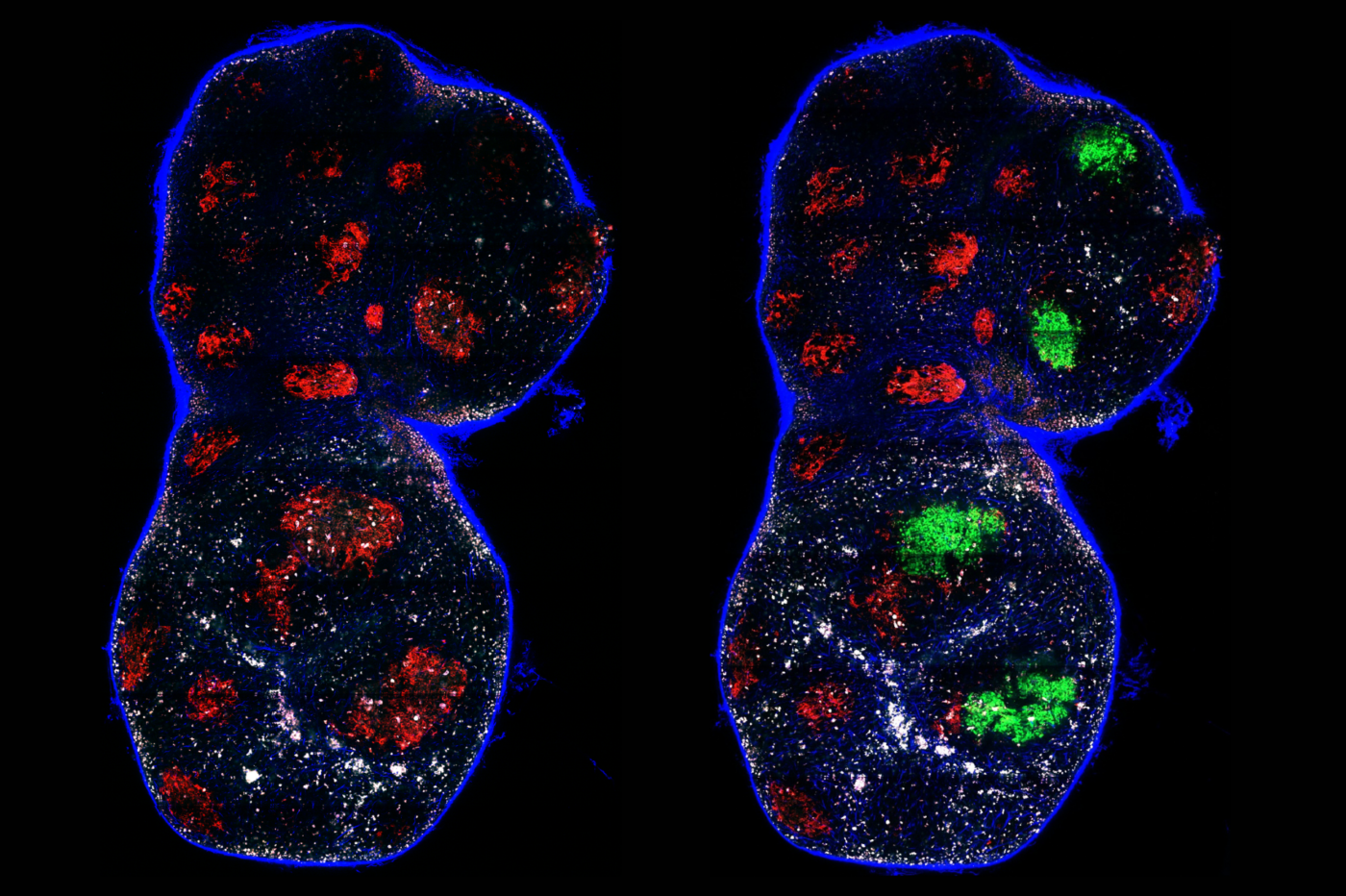
Side-by-side images of germinal centers before and after photoactivation. Researchers used a novel technique to study in fine detail the evolution of high affinity B cells. (Credit: Tatsuya Araki, Victora Lab)
<関連情報>
- https://www.rockefeller.edu/news/39873-germinal-center-immune-evolution/
- https://www.cell.com/cell/fulltext/S0092-8674(26)00572-6
定量化された親和性ランドスケープ上で胚中心の進化を再現する Replaying germinal center evolution on a quantified affinity landscape
William S. DeWitt ∙ Ashni A. Vora ∙ Tatsuya Araki ∙ … ∙ Tyler N. Starr ∙ Frederick A. Matsen, IV ∙ Gabriel D. Victora
Cell Published:June 5, 2026
DOI:https://doi.org/10.1016/j.cell.2026.05.013
Highlights
- GCs yield predictable phenotypic outcomes despite variable phylogenetic trajectories
- Presence of low-affinity B cells in GCs is not evidence of permissive selection
- Imperfect but persistent selection of higher-affinity B cells drives affinity maturation
- We infer a full genotype-phenotype-fitness landscape for GC evolution
Summary
Darwinian evolution of immunoglobulin genes within germinal centers (GCs) underlies the progressive increase in antibody affinity following antigen exposure. Whereas the cellular mechanics of how competition between B cells increases affinity are well established, the evolutionary dynamics of this process are less clear. We developed an experimental evolution model in which we “replay” over one hundred monoclonal GC reactions, assigning affinities to each cell using deep mutational scanning. Our data reveal how GCs achieve predictable outcomes by means of noisy but persistent selection on an affinity landscape whose exploration is heavily constrained by somatic hypermutation biases. We infer a fitness landscape that quantitatively recapitulates the affinity maturation trajectory of our clone and find that apparent features of GC selection, such as permissiveness to low-affinity lineages and rapid plateauing of affinity, are likely artifacts of survivorship biases that distort our view of how B cell affinity progresses over time.