2026-07-28 京都大学
作成:淺岡希美
<関連情報>
- https://www.kyoto-u.ac.jp/ja/research-news/2026-07-28
- https://www.nature.com/articles/s41467-026-75706-1
意思決定戦略と習慣行動の実行における前頭前皮質可塑性が果たす異なる役割 Dissociable roles of prefrontal plasticity in decision-making strategy and execution of habitual behavior
Nozomi Asaoka,Diane Pagano & Yasunori Hayashi
Nature Communications Published:27 July 2026
DOI:https://doi.org/10.1038/s41467-026-75706-1
Abstract
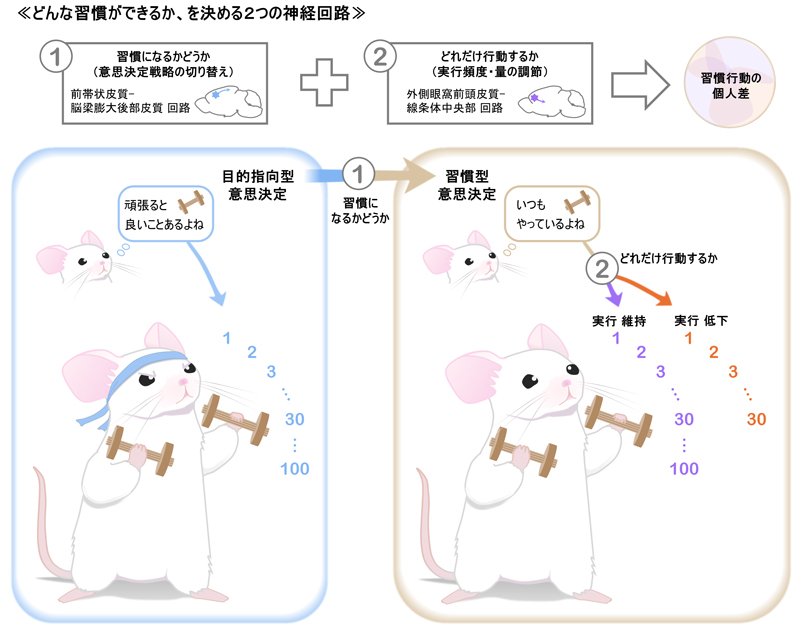
Habits are essential for sustaining adaptive behaviors but can also lead to maladaptive behaviors such as compulsive and addictive disorders. They emerge through a shift in decision-making from motivation-driven strategy to an automatic one. During this, the level of habit execution, such as frequency and duration, is superficially maintained despite a decline in motivational drive, raising the question of how the amount of execution is maintained even when decision-making strategies undergo substantial changes. By developing a unique paradigm capable of inducing habit formation within a defined time window in male mice, we found that shift in decision-making and amount of habit execution are controlled by plasticity in distinct cortical pathways. Erasure of each plasticity selectively altered the decision-making strategy or the execution level without affecting the other. These findings reveal a dual regulatory model for habit, providing insights into the neurocircuit mechanisms underlying both adaptive and maladaptive habits.