2026-06-12 名古屋市立大学
◆報酬と関連付けた音を学習したマウスを用いた実験では、音を提示する直前のヒスタミン神経活動が高いほど、記憶に基づく行動(報酬予測の舐め行動)が強く現れた。さらに、ヒスタミン神経活動が高いタイミングで手がかりを提示すると、記憶の表出頻度が約40%増加し、逆に活動を抑制すると記憶の表出が低下した。また、ヒスタミン神経は扁桃体基底外側核の神経集団を事前に整え、記憶に対応する神経活動パターンを再現しやすい「準備状態」を形成していることも判明した。
◆本研究は、記憶障害を単なる記憶喪失ではなく「記憶へのアクセス障害」として捉える新たな視点を提供し、認知症や加齢に伴う認知機能変動の理解や治療法開発につながる可能性がある。成果は学術誌『Neuron』に掲載された。
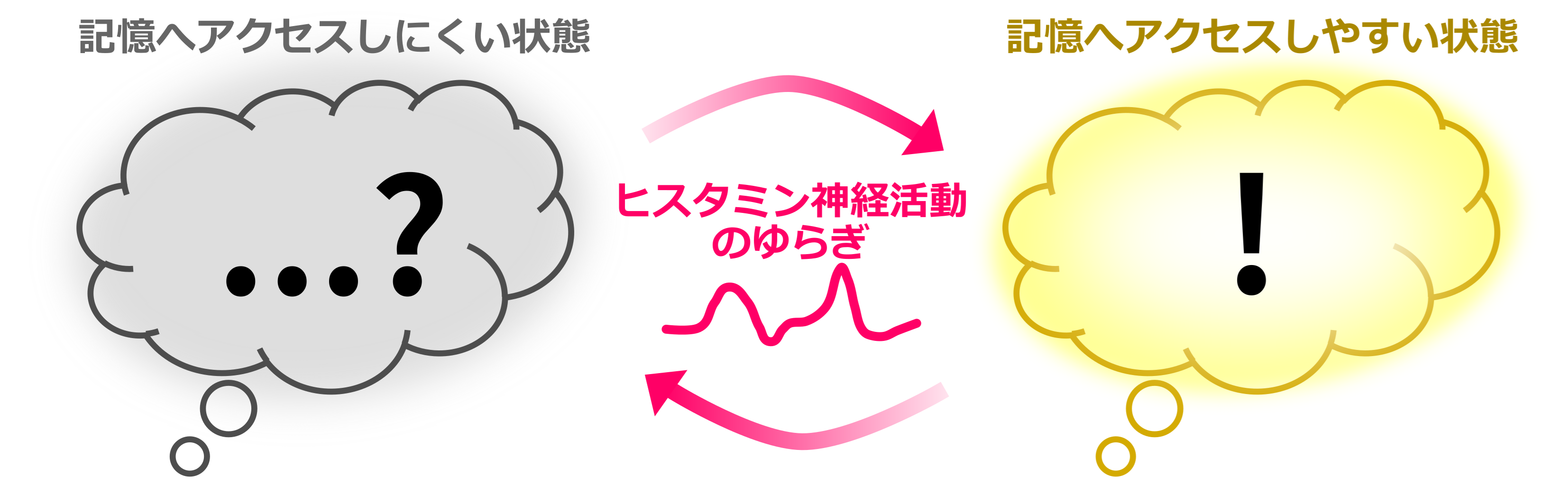
図1:脳内ヒスタミン神経活動のゆらぎにより、保存された記憶へアクセスしやすい状態とアクセスしにくい状態が移り変わることを示す模式図。
<関連情報>
- https://www.nagoya-cu.ac.jp/press-news/202606120000/
- https://www.cell.com/neuron/fulltext/S0896-6273(26)00411-3
超低速ヒスタミン作動性ダイナミクスは、瞬間的な記憶へのアクセスを制御するプライミング状態を司る Infraslow histaminergic dynamics govern priming states to gate moment-to-moment memory accessibility
Yoshikazu Morishita ∙ Yuki Takamura ∙ Kyoka Nishimura ∙ … ∙ Natsuko Hitora-Imamura ∙ Masabumi Minami ∙ Hiroshi Nomura
Neuron Published:June 11, 2026
DOI:https://doi.org/10.1016/j.neuron.2026.05.019
Highlights
- Infraslow histaminergic neuronal activity tracks an integrated brain-body state
- Pre-cue histaminergic activity predicts and gates trial-by-trial memory expression
- Optogenetic manipulation of histaminergic neurons modulates memory expression
- Histaminergic activity supports canonical cue-evoked amygdala population responses
Summary
Memory expression fluctuates even in response to identical cues, which suggests that ongoing brain states bias memory accessibility. However, the cellular and circuit principles governing these state-dependent fluctuations remain unclear. Here, we show that spontaneous pre-cue activity of histaminergic neurons in the hypothalamic tuberomammillary nucleus (TMN) modulates the expression of reward-associative memory in mice. TMN histaminergic activity exhibited infraslow dynamics (0.05–0.1 Hz) that closely tracked an integrated brain-body state. Closed-loop cue delivery during high histaminergic states enhanced memory expression. Brief optogenetic activation or inhibition of these neurons before the cue bidirectionally modulated memory expression, and direct activation of histaminergic terminals in the basolateral amygdala (BLA) was sufficient to enhance memory expression. Furthermore, histaminergic inhibition before the cue impaired the cue-evoked BLA population response. Thus, ongoing histaminergic activity exerts an infraslow, state-setting influence that primes BLA circuits for robust cue responses and, in turn, modulates moment-to-moment memory accessibility.