
2026-06-12 ロックフェラー大学
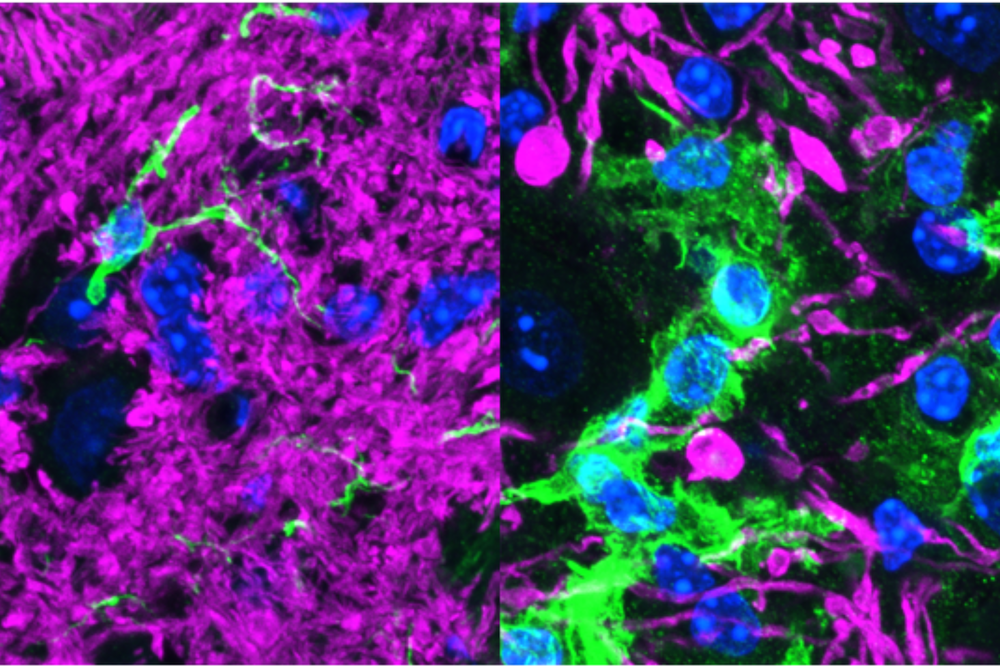
Left: Nerve fibers from healthy brain tissue are shown in magenta with support cells called glia in green. Right: Neurons deprived of PI31 are swollen and damaged. Glia are activated and enlarged as they try to remove faulty connections between cells. (Credit: Steller lab)
<関連情報>
- https://www.rockefeller.edu/news/39905-alzheimers-parkinsons-mutations-protein-clumps-neurodegenerative-diseases/
- https://www.nature.com/articles/s41467-026-71351-w
- https://medibio.tiisys.com/164747/
- https://www.cell.com/developmental-cell/fulltext/S1534-5807(19)30527-1
プロテアソーム調節因子PSMF1の変異は、パーキンソン病から周産期致死に至るまで、多様な表現型を引き起こす Variants in the proteasome regulator PSMF1 cause a phenotypic spectrum from parkinsonism to perinatal lethality
Francesca Magrinelli,Christelle Tesson,Plamena R. Angelova,Jose A. Rodriguez,Annarita Scardamaglia,Benjamin O’Callaghan,Simon A. Lowe,Ainara Salazar-Villacorta,Brian Hon-Yin Chung,Matthew Jaconelli,Barbara Vona,Noemi Esteras,Angela Mammana,Junko Shimazu,Anna Ka-Yee Kwong,Thomas Courtin,Shahryar Alavi,Reza Maroofian,Raja Nirujogi,Mariasavina Severino,Edoardo Monfrini,Clarissa Rocca,Patrick A. Lewis,Stephanie Efthymiou,PSMF1 Study Group,… Henry Houlden
Nature Communications Published:15 April 2026
DOI:https://doi.org/10.1038/s41467-026-71351-w Unedited version
Abstract
Dissecting biological pathways highlighted by Mendelian gene discovery has provided critical insights into the pathogenesis of Parkinson’s disease (PD) and neurodegeneration. This approach ultimately catalyzes the identification of potential biomarkers and therapeutic targets. Here we identify PSMF1 as a gene implicated in parkinsonism and childhood neurodegeneration. We find that biallelic PSMF1 missense and loss-of-function variants co-segregate with phenotypes from early-onset PD to perinatal lethality with neurological manifestations across 18 pedigrees with 25 affected subjects, showing clear genotype-phenotype correlation. PSMF1 encodes the proteasome regulator PSMF1/hPI31, a highly conserved, ubiquitously expressed partner of the 20S proteasome and neurodegeneration-associated F-box-O 7 and valosin-containing proteins. We demonstrate that PSMF1 variants may affect proteasomal abundance and assembly, and are associated with alterations of mitochondrial membrane potential, respiration, dynamics and mitophagy in patient-derived fibroblasts. Furthermore, Drosophila and mouse models of PI31 loss of function exhibit age-dependent motor impairment, as well as brain-wide mitochondrial membrane depolarization and dopaminergic neurodegeneration in aged flies, and diffuse gliosis in mice. Collectively, our findings unequivocally link defective PSMF1/hPI31 to early-onset parkinsonism and neurodegeneration, and suggest proteasomal and mitochondrial dysfunction as pathogenic contributors.
PI31は軸索におけるプロテアソーム輸送のためのアダプタータンパク質であり、シナプス発達に必要である PI31 Is an Adaptor Protein for Proteasome Transport in Axons and Required for Synaptic Development
Kai Liu ∙ Sandra Jones ∙ Adi Minis ∙ Jose Rodriguez ∙ Henrik Molina ∙ Hermann Steller
Developmental Cell Published: July 18, 2019
DOI:https://doi.org/10.1016/j.devcel.2019.06.009
Highlights
- PI31 directly mediates the formation of dynein light chain-proteasome complexes
- PI31 is required for axonal transport of proteasomes in Drosophila and mice
- Stress regulates PI31 activity through p38 MAPK-mediated phosphorylation
- This mechanism is required for protein homeostasis and structure of synapses
Summary
Protein degradation by the ubiquitin-proteasome system is critical for neuronal function. Neurons utilize microtubule-dependent molecular motors to allocate proteasomes to synapses, but how proteasomes are coupled to motors and how this is regulated to meet changing demand for protein breakdown remain largely unknown. We show that the conserved proteasome-binding protein PI31 serves as an adaptor to couple proteasomes with dynein light chain proteins (DYNLL1/2). The inactivation of PI31 inhibited proteasome motility in axons and disrupted synaptic proteostasis, structure, and function. Moreover, phosphorylation of PI31 by p38 MAPK enhanced binding to DYNLL1/2 and promoted the directional movement of proteasomes in axons, suggesting a mechanism to regulate loading of proteasomes onto motors. Inactivation of PI31 in mouse neurons attenuated proteasome movement in axons, indicating this process is conserved. Because mutations affecting PI31 activity are associated with human neurodegenerative diseases, impairment of PI31-mediated axonal transport of proteasomes may contribute to these disorders.

