2026-06-22 国立精神・神経医療研究センター,福島大学
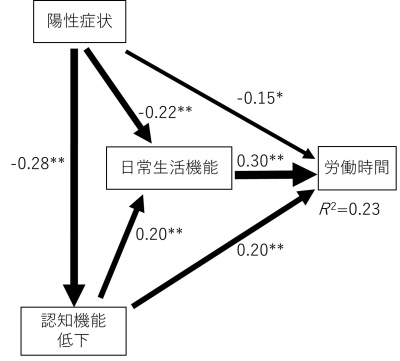
図1:統合失調症患者における陽性症状・認知機能低下・日常生活機能・労働時間の関連構造
<関連情報>
- https://www.ncnp.go.jp/topics/detail.php?@uid=HigB1Q7d0HjppQDE
- https://www.sciencedirect.com/science/article/pii/S2215001326000272
統合失調症患者の就労成果に関する多層モデル:陽性症状、認知機能、日常生活技能間の関係性の検討 A multilayered model of work outcome in patients with schizophrenia: Examination of the relationships among positive symptoms, cognition, and daily living skills
Satsuki Ito, Junya Matsumoto, Chika Sumiyoshi, Yuka Yasuda, Michiko Fujimoto, Hidenaga Yamamori, Harumasa Takano, Tomiki Sumiyoshi, Ryota Hashimoto
Schizophrenia Research: Cognition Available online: 19 June 2026
DOI:https://doi.org/10.1016/j.scog.2026.100444
Abstract
Patients with schizophrenia often show impairments in work functioning, yet the precise relationships among positive symptoms, cognition, daily living skills, and work outcome remain to be elucidated.
We analyzed data from 396 patients with schizophrenia and 1109 healthy individuals. Work outcome was quantified as the mean weekly working hours. Cognitive decline was defined as the difference between current and premorbid IQ, while social function was evaluated by the Social Functioning Scale. We also conducted group comparisons and correlational analyses among the clinical variables. Using structural equation modeling (SEM), we further examined pathways from positive symptoms through cognitive decline, and determined whether daily living skills account for work outcome.
Patients showed impairments in work outcome, cognitive decline, and social function, including daily living skills, as represented by Independence–Performance subscale of the Social Functioning Scale. Consistent with previous studies, cognitive decline and social function were correlated with weekly working hours among patients. SEM revealed several pathways from positive symptoms to working hours via daily living skills with or without a mediational effect of cognitive decline.
The findings suggest that work outcome is influenced by multiple clinical symptom domains, including positive symptoms, cognitive decline, and daily living skills. The observed relationships among these features may aid in the development of effective interventions for occupational function in patients with schizophrenia.