
2026-06-29 大阪公立大学
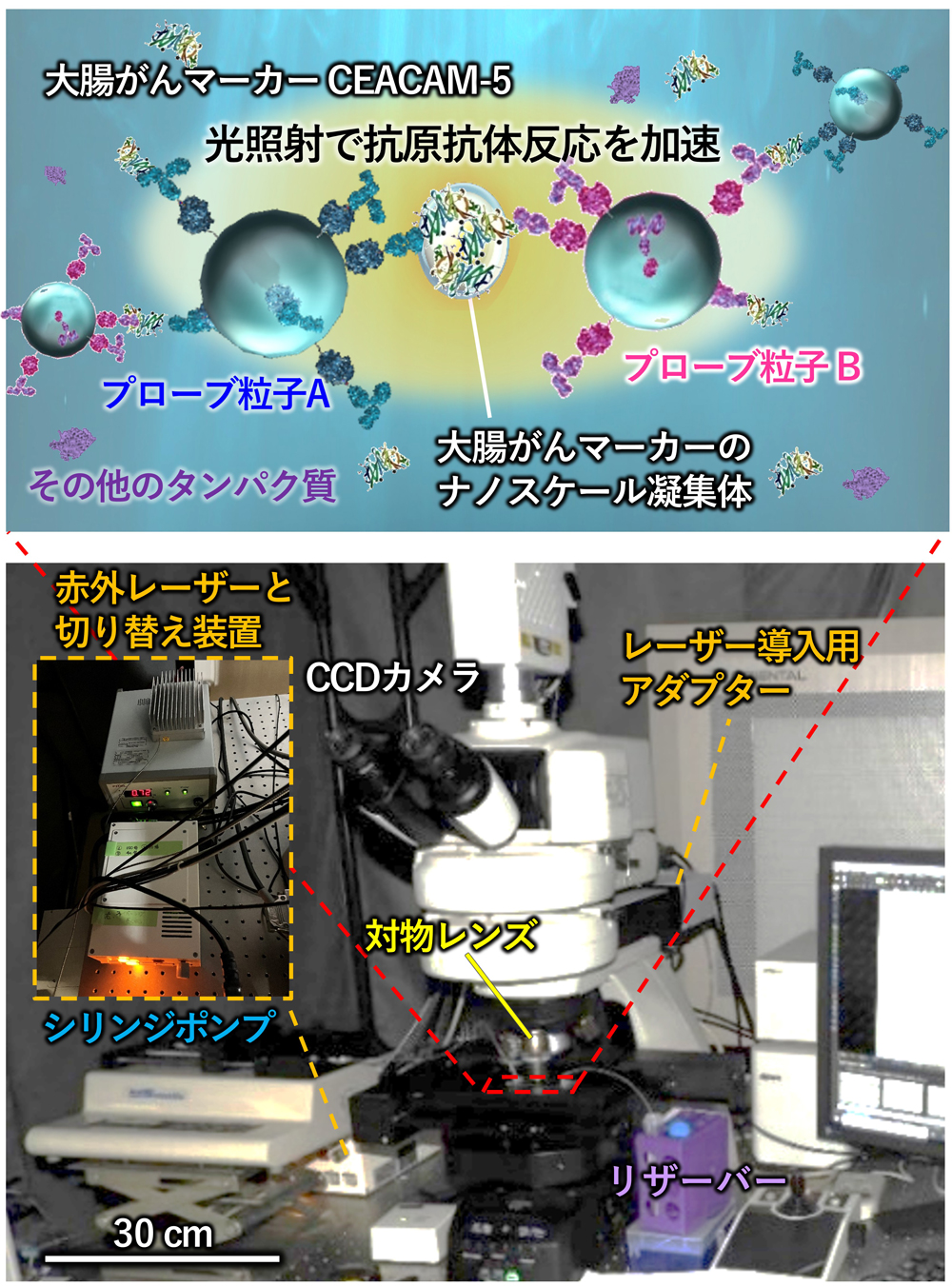
図1:(上)MF-LAC-SYSで抗体修飾ビーズを用いてCEACAM-5とナノスケール凝集体を高感度検出するイメージ。(下)MF-LAC-SYS標準機の写真。
<関連情報>
- https://www.omu.ac.jp/info/research_news/entry-24709.html
- https://pubs.rsc.org/en/content/articlelanding/2026/nh/d6nh00017g
光照射によるCEACAM-5と抗体との特異的結合の促進による大腸がんの早期発見 Light-induced acceleration of specific binding between CEACAM-5 and antibodies for early detection of colorectal cancer
Takuya Iida, Yumiko Takagi,Mami Katsumata,Hisanori Isomura,Koji Komori,Mamoru Tamura,Hiroko Yamakawa,Yusuke Nakamura,Kota Hayashi,Ikuhiko Nakase,Shiho Tokonami and Ayumu Taguchi
Nanoscale Horizons Published:29 Jun 2026
DOI:https://doi.org/10.1039/D6NH00017G
Abstract
Immunoassay methods such as enzyme-linked immunosorbent assay using antigen–antibody reactions have been applied to detect biomarker proteins in the case of various diseases (e.g., cancer). However, these methods comprise several-hour-long pre-treatment processes (incubation and washing) before detection, and their sensitivity is limited by the affinity of protein and antibody sets. Here, we demonstrate the rapid and highly sensitive analysis of a cancer biomarker at several hundreds of attograms using a microflow-type light-induced acceleration system (MF-LAC-SYS) to enhance the reaction between the multiple antibodies and glycoprotein (CEACAM-5) from human plasma containing multiple impurities with the help of theoretical analysis. Adjusting the surface charge of the antibody-modified beads and buffer solution components, we could detect pg mL−1 levels of CEACAM-5 at high sensitivity under a laser beam irradiation of several hundred mW for several minutes at a defocused condition equivalent to the microchannel width. Specifically, we discovered the existence of nanoscale CEACAM-5 aggregates related to the sensitivity of the MF-LAC-SYS, using dynamic light scattering and electron microscopy. The results will potentially pave the way for a platform using unconventional immunoassays for liquid biopsy and blood proteomics.
