2026-06-30 中国科学院(CAS)
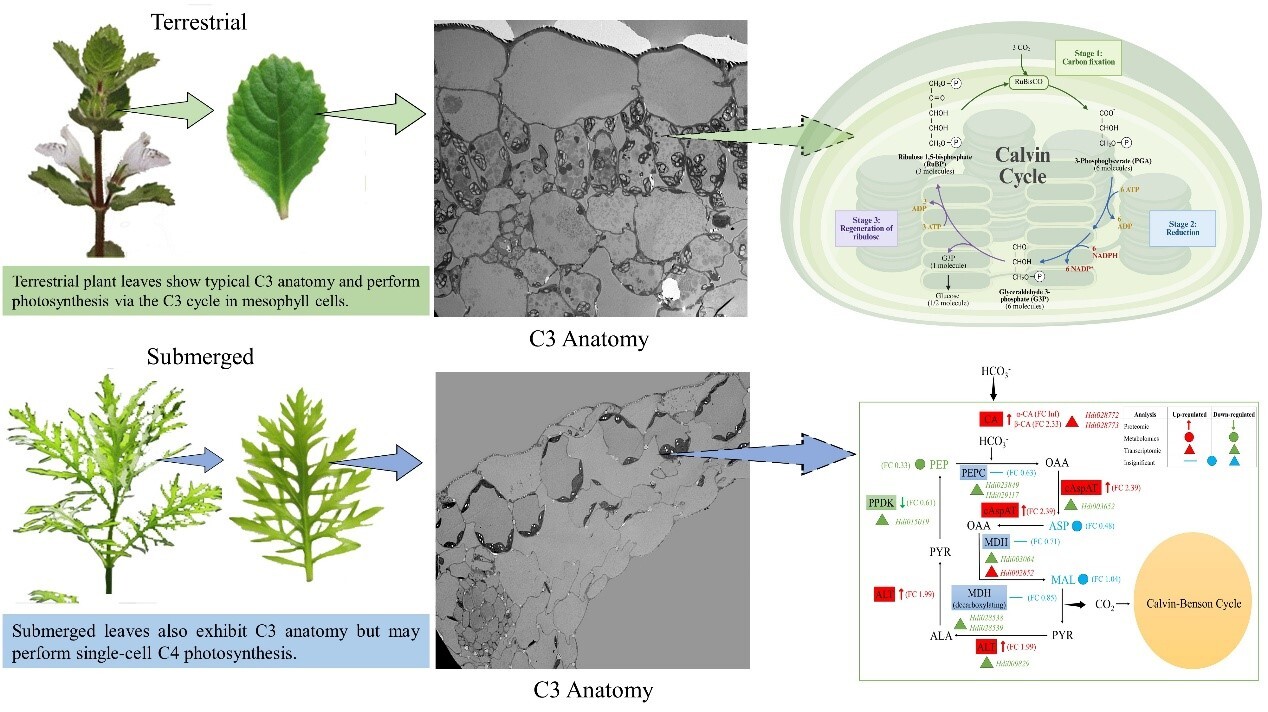
Phenotypic, anatomical, and physiological adaptation of H. difformis in terrestrial and submerged conditions. (Image by IHB)
<関連情報>
- https://english.cas.cn/newsroom/research-news/202606/t20260630_1175118.shtml
- https://academic.oup.com/hr/advance-article/doi/10.1093/hr/uhag230/8708086?login=false
光合成と炭素利用に関する生理学的およびマルチオミクス解析により、水没した Hygrophila difformisにおける生化学的炭素濃縮機構(CCM)が明らかになった Physiological and multi-omics analyses on photosynthesis and carbon utilization reveal biochemical carbon concentrating mechanisms (CCMs) in Hygrophilla difformis under submergence
Abeer Kazmi,Gaojie Li,Jingjing Yang,Xuyao Zhao,Md Fakhrul Islam,Xiaozhe Li,Dwi Fajar Sidhiq,Seisuke Kimura,Keiko U Torii,Hongwei Hou
Horticulture Research Published:15 June 202
DOI:https://doi.org/10.1093/hr/uhag230
Abstract
Hygrophila difformis is an ornamental amphibious plant that develops distinct terrestrial (shallow-serrated) and submerged (deep-lobed) leaf forms in response to environmental conditions. Although previous studies have reported bicarbonate (HCO₃ −) utilization and highlighted the involvement of carbonic anhydrase in inorganic carbon uptake, the photosynthetic strategy and carbon assimilation pathway operating under submergence remain unclear. Here, we applied an integrated framework combining physiological measurements, enzyme activity assays, transcriptomic, proteomic, and metabolomic profiling, stable carbon isotope analysis, and ultrastructural observations to compare terrestrial and submerged leaves. Submerged leaves displayed a δ 13C value of −20.068‰, indicating a substantial shift toward C₄-like photosynthetic metabolism under aquatic conditions. Consistent with this signature, activities of key carboxylation and decarboxylation enzymes were significantly elevated, supporting a transition from C₃ photosynthesis toward an NAD-malic enzyme (NAD-ME)–type C₄ pathway. Multi-omics analyses revealed extensive reprogramming of photosynthetic and starch metabolic networks in response to submergence, with strong upregulation of genes and metabolites associated with the NAD-ME–type C₄ cycle, including cytosolic aspartate aminotransferase and alanine aminotransferase, accompanied by coordinated downregulation of Calvin cycle components. By contrast, terrestrial leaves retained high Rubisco activity and strong expression of Calvin cycle genes, consistent with classical C₃ photosynthesis. RT-qPCR analyses demonstrated marked induction of carbonic anhydrase genes under submerged conditions, with HdαCA9 showing a 194-fold increase in transcript abundance, highlighting its central role in underwater carbon utilization. Transmission electron microscopy further revealed dimorphic chloroplasts within submerged mesophyll cells. Collectively, results demonstrate plasticity in H. difformis and provide insights into C₄-like carbon assimilation strategies in amphibious plants.