2026-07-01 大阪公立大学
<関連情報>
- https://www.omu.ac.jp/info/research_news/entry-24761.html
- https://www.nature.com/articles/s42003-026-10402-w
コオロギモデルにおける母体胚休眠を支える転写およびエピゲノムプログラミングの時間的制御 Temporal orchestration of transcriptional and epigenomic programming underlying maternal embryonic diapause in a cricket model
Kosuke Kataoka,Yuta Shimizu,Ryuto Sanno,Yuichi Koshiishi,Ken Naito,Kei Yura,Toru Asahi & Shin G. Goto
Communications Biology Published:30 June 2026
DOI:https://doi.org/10.1038/s42003-026-10402-w
Abstract
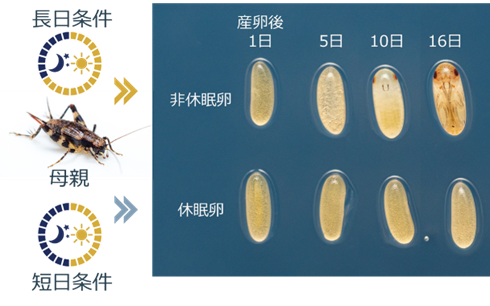
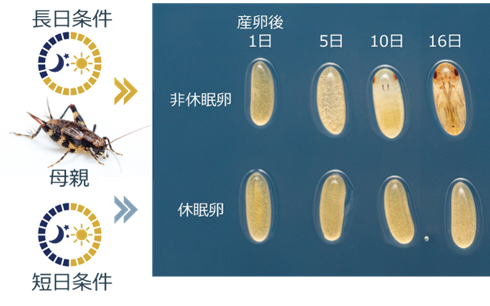
Maternal perception of environmental conditions can direct offspring developmental trajectories, providing adaptive flexibility across taxa. In the band-legged ground cricket Dianemobius nigrofasciatus, maternal exposure to short days induces embryonic diapause at the cellular blastoderm stage in offspring. Here, we investigate molecular mechanisms underlying this transgenerational adaptation through genome assembly (1.45 Gbp) and a time-series transcriptomic analysis of diapause and non-diapause eggs from 12 to 72 hours post-oviposition. Despite morphological similarity, diapause-destined eggs show early upregulation of ATP-dependent chromatin remodeling genes at 24 hours. ATAC-seq reveals reduced chromatin accessibility at neural and cell cycle-related genes. Time-series clustering identifies precocious shifts in RNA processing machinery (peaking at 24 versus 40 hours in non-diapause eggs), followed by metabolic regulation toward amino acid catabolism and gluconeogenesis sustaining long-term survival during developmental arrest. Our findings reveal diapause as actively coordinated molecular programming involving epigenetic, transcriptional, and metabolic remodeling, providing insights into transgenerational environmental adaptation.