2026-06-17 中国科学院(CAS)
中国科学院新疆生態・地理研究所の研究チームは、中国北西部の温帯砂漠に生育する10種の低木を対象に、夏季の深刻な干ばつと冬季の凍結融解という二重の環境ストレスへの適応機構を調査した。その結果、「有縁壁孔(vestured pits)」と呼ばれる木部の微細構造を持つ植物は、水の輸送効率が高く、干ばつ時に導管内で発生する気泡(塞栓)に対する耐性も優れていることが分かった。一方で、こうした植物は凍結融解によって生じる塞栓には比較的弱い傾向があり、乾燥耐性と耐寒性の間にトレードオフが存在することが示された。また、有縁壁孔を持つ種では導管径が大きく壁孔膜が薄いなどの特徴が確認され、これらが効率的な水輸送を支えていることも明らかになった。本研究は、乾燥地植物の生存戦略や進化を理解するうえで重要な知見を提供するとともに、気候変動による乾燥化が進む地域の生態系保全や植生変化の予測に役立つ成果である。
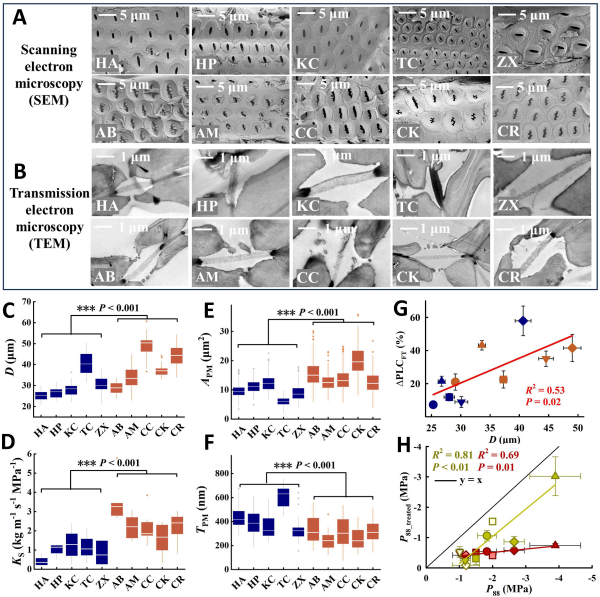
Stem xylem structural and hydraulic functions in the desert shrub species with non-vestured pits or vestured pits. (Image by XIEG)
<関連情報>
- https://english.cas.cn/newsroom/research-news/202606/t20260619_1174332.shtml
- https://onlinelibrary.wiley.com/doi/abs/10.1111/pce.70630
被覆された窪みは、砂漠の低木の水分輸送戦略を変化させ、干ばつや凍結ストレスに対処する Vestured Pits Modify the Hydraulic Strategies of Desert Shrubs to Cope With Drought and Freezing Stresses
Chun-Yang Duan, Guang-You Hao, Chi Zhang, Jing Zhang, Lan Peng, Yuan-Ming Zhang
Plant,cell & Environment Published: 27 May 2026
DOI:https://doi.org/10.1111/pce.70630
Summary statement
The adaptive significance of vestured pits in desert shrubs lies in their capacity to enhance drought-induced xylem embolism resistance and, in the meantime, allow for relatively high hydraulic efficiency; however, this adaptation comes at a cost of increased susceptibility to freezing-induced embolism.