2026-06-30 チャルマース工科大学
<関連情報>
- https://news.cision.com/chalmers/r/restoring-lost-senses–one-technology-for-both-artificial-vision-and-touch,c4367797
- https://www.nature.com/articles/s44222-026-00449-z
- https://medibio.tiisys.com/147296/
皮質微小刺激による視覚と触覚の回復 Restoring vision and touch with cortical microstimulation
Giacomo Valle,Denise Oswalt,Robert A. Gaunt,Pieter Roelfsema,Charles M. Greenspon & Eduardo Fernandez
Nature Reviews Bioengineering Published:01 June 2026
DOI:https://doi.org/10.1038/s44222-026-00449-z
Abstract
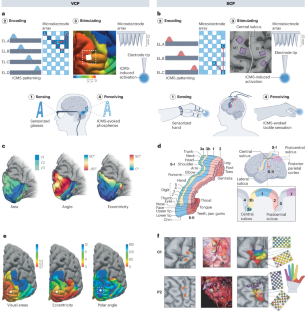
The restoration of sensory function following injury or disease represents a critical challenge in neuroengineering. Sensory neuroprostheses, particularly those targeting the primary visual (V1) and somatosensory (S1) cortices, promise to bypass damaged afferent pathways and reintroduce sensory percepts through direct cortical stimulation. Building on foundational insights from non-human primate research, epicortical and intracortical microstimulation has been used to evoke artificial visual and tactile experiences in early human trials. In this Review, we examine the state of cortical sensory prostheses, focusing on visual and somatosensory applications. We compare neural encoding strategies for touch and vision, discuss the technical and clinical requirements of cortical stimulation, and evaluate the qualitative advantages of these devices over conventional assistive technologies. We also highlight emerging directions, including biomimetic encoding, multisensory integration and alternative implant sites, that could enhance the fidelity and usability of future interfaces. Together, these developments mark a critical step towards clinically viable, high-resolution restoration of naturalistic sensation.
Key points
- Sensory neuroprosthetics aims to restore vision and touch by bypassing damaged pathways and stimulating intact cortical areas.
- Epicortical and intracortical microstimulation evokes artificial percepts like phosphenes and tactile sensations via direct cortical activation.
- Visual and somatosensory cortical prostheses have shown promising functional results in preclinical and early human trials.
- Cortical sensory prosthetics outperform traditional aids in spatial resolution and sensory realism.
- Understanding the differences in neural encoding of touch and vision is critical for designing effective neuroprosthetic systems.
- Future directions include improved neural interfaces, robotic technology and targeting novel brain regions.