2026-07-14 中国科学院(CAS)
<関連情報>
- https://english.cas.cn/newsroom/research-news/202607/t20260714_1178367.shtml
- https://onlinelibrary.wiley.com/doi/10.1002/imt2.70134
百歳以上の高齢者における微生物のキーストーン分類群と代謝シグネチャーは、加齢に伴う腸内恒常性を制御する Microbial keystone taxa and metabolic signatures in centenarians regulate intestinal homeostasis during aging
Wei-Chuan Lin, Cui Zhang, He-Hua Lei, Zheng Cao, Xin Gao, Wen-Kai Yu, Xin-Zhi Li, Qing-Wei Xiang, Zhi-Wen Zhang, Shi-Fu Pang, Wei-Fei Luo, Deng-Hui Xie, Li-Min Zhang, Gang Chen
iMeta Published: 19 May 2026
DOI:https://doi.org/10.1002/imt2.70134
Abstract
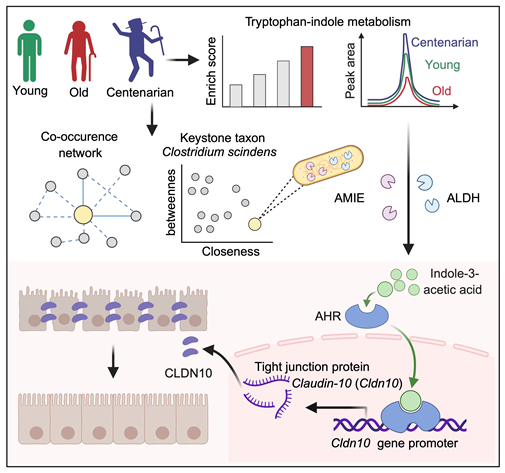
Microbial networks and keystone taxa play pivotal roles in maintaining gut microecological stability and host homeostasis, irrespective of their abundance. However, most previous studies of aging-associated gut microbiota have relied on abundance-based analyses, largely overlooking microbial networks and microbe-host interactions. Here, we employed a co-occurrence network approach to identify keystone taxa during aging in humans and mice. We found that centenarians harbor distinctive keystone taxa dominated by members of Clostridium, of which Clostridium scindens (C. scindens) can significantly enhance microbial network stability, probably contributing to longevity and reduced susceptibility to age-related diseases. Mechanistically, C. scindens produces indole-3-acetic acid (IAA) from tryptophan via the enzymes amidase (AMIE) and aldehyde dehydrogenase (ALDH). Oral administration of either C. scindens or IAA effectively mitigates intestinal aging by restoring gut barrier dysfunction in aged mice. Further analysis revealed that C. scindens-derived IAA restores intestinal dysfunction through activation of aryl hydrocarbon receptor (AHR) signaling, leading to upregulation of intestinal CLDN10, a key tight junction protein. Structurally, IAA enhances Claudin–10 transcription by promoting AHR binding to its promoter region. Our findings provide new insights into the characterization of microbial networks in centenarians and highlight that C. scindens and IAA may contribute to healthy longevity by promoting gut microecological stability and host homeostasis.
Highlights
- A co-occurrence network analysis identifies keystone taxa dominated by members of Clostridium in centenarians.
- Clostridium scindens enhances microbial network stability, probably contributing to longevity and reduced susceptibility to age-related diseases.
- Clostridium scindens produces indole-3-acetic acid (IAA) from tryptophan metabolism via its own enzymes amidase (AMIE) and aldehyde dehydrogenase (ALDH).
- Clostridium scindens-derived IAA promotes intestinal homeostasis by facilitating aryl hydrocarbon receptor (AHR)-mediated CLDN10 signaling in aged mice.