2026-07-22 大阪医科薬科大学,国立がん研究センター,川崎医科大学
<関連情報>
- https://www.ncc.go.jp/jp/information/pr_release/2026/0722/index.html
- https://www.nature.com/articles/s41392-026-02847-6
筋層浸潤性膀胱癌における膀胱温存化学放射線療法に対する抵抗性は、フェロトーシス抑制状態によって引き起こされる A ferroptosis-suppressive state drives resistance to bladder-preserving chemoradiotherapy in muscle-invasive bladder cancer
Takuya Tsujino,Shogo Yamazaki,Moritoshi Sakamoto,Yuki Yoshikawa,Ryoichi Maenosono,Yuki Nakajima,Kensuke Hirosuna,Tomoaki Takai,Kazuki Nishimura,Mitsuaki Ishida,Ko Nakamura,Kengo Iwatsuki,Shuya Tsuchida,Takuya Matsuda,Takuya Higashio,Tatsuo Fukushima,Kyosuke Nishio,Keita Nakamori,Takeshi Tsutsumi,Tomohisa Matsunaga,Kohei Taniguchi,Taiju Shimbo,Tomohito Tanaka,Kiyoshi Takahara,… Haruhito Azuma
Signal Transduction and Targeted Therapy Published:02 July 2026
DOI:https://doi.org/10.1038/s41392-026-02847-6
Abstract
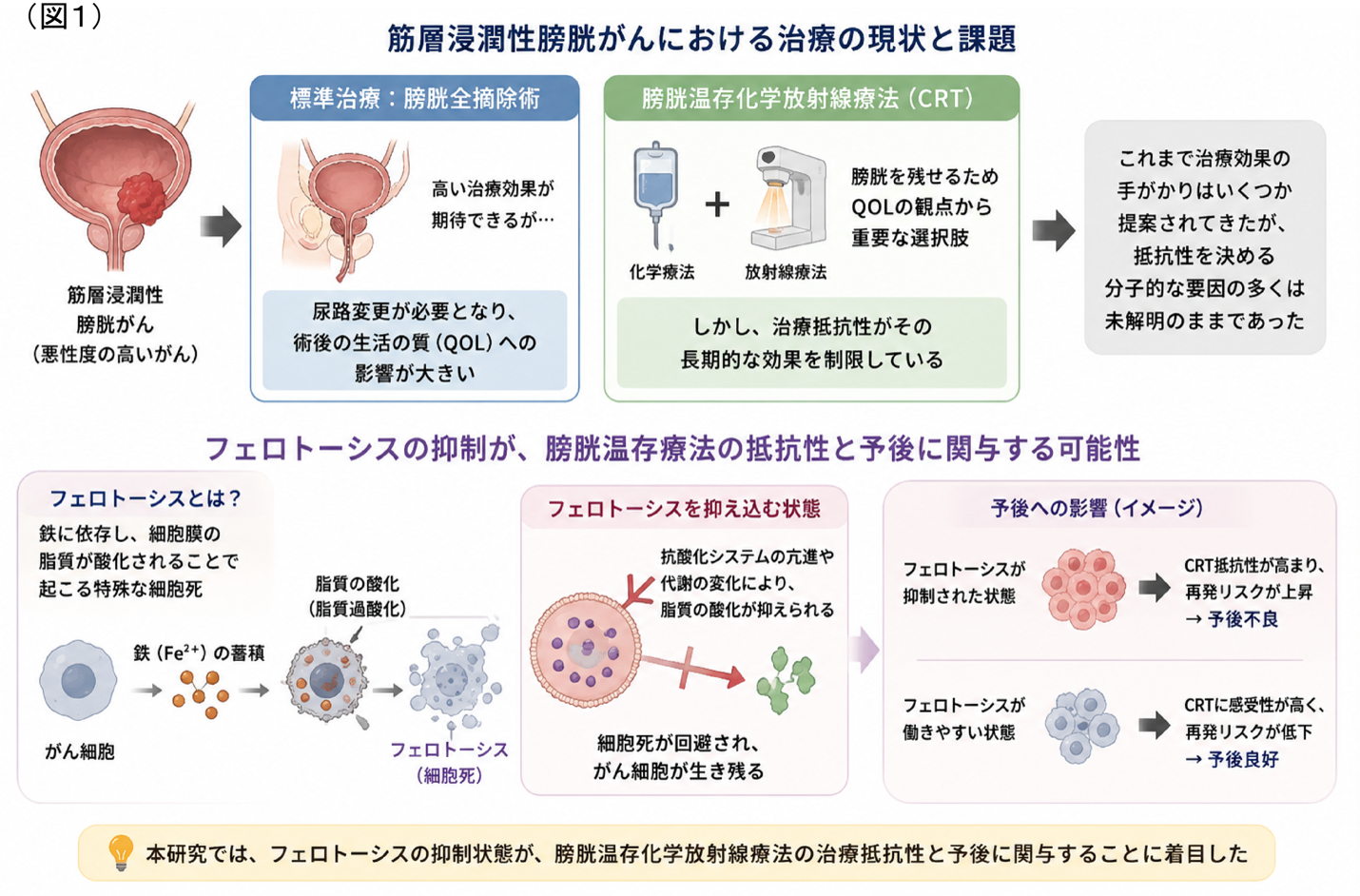
Bladder-preserving trimodality therapy (TMT) incorporating concurrent chemoradiotherapy (CRT) provides a curative-intent alternative to radical cystectomy for muscle-invasive bladder cancer (MIBC), yet its efficacy is frequently limited by intrinsic treatment resistance, the molecular basis of which remains poorly defined. To address this, we performed bulk transcriptomic profiling of pretreatment tumors from 179 patients uniformly treated with bladder-preserving CRT and systematically integrated gene expression data with tumor immune features and clinical outcomes. We identified a ferroptosis-suppressive transcriptional signature (FSS) associated with a distinct resistance-associated tumor state that independently stratified radiographic progression-free survival and overall survival following CRT. FSS-high tumors were characterized by inferior outcomes, enrichment of basal/squamous and immune-excluded phenotypes, and reduced intratumoral immune infiltration, whereas FSS-low tumors preferentially exhibited luminal unstable and immune-inflamed features. Consistent with clinical observations, a ferroptosis-suppressive transcriptional program was recapitulated in CRT-resistant bladder cancer cell line models. Genome-wide CRISPR/Cas9 loss-of-function screening further identified core ferroptosis suppressors as functionally relevant dependencies specifically under irradiation stress, and pharmacologic induction of ferroptosis effectively restored radiosensitivity in otherwise resistant cells. Together, these findings support ferroptosis suppression as a biologically relevant resistance-associated state that mechanistically links tumor-intrinsic transcriptional programs to immune contexture and therapeutic vulnerability and provide a translational framework for improved risk stratification and future treatment refinement in bladder-preserving therapy for MIBC.